
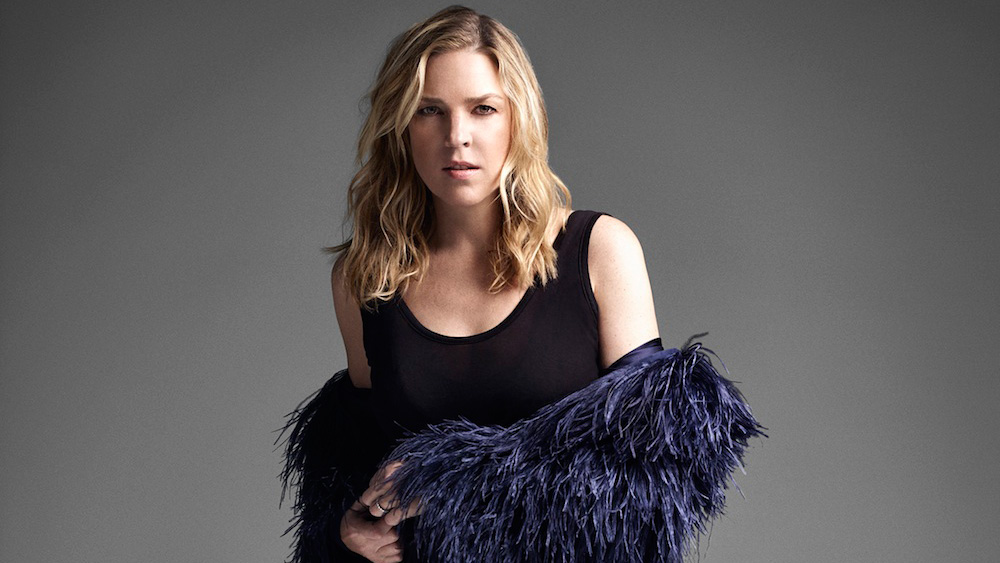
To fully understand Diana Krall’s latest album, “Wallflower,” a person may have to be exactly 50 years old.
Krall turned 50 last November and I will turn 50 in September.
Some fans and critics have been a little bewildered by the album, which consists of fairly straightforward renditions (Krall doesn’t want them described as cover tunes) of pop hits from the ‘60s, ‘70s and ‘80s.
Krall, ostensibly a jazz pianist and chanteuse, doesn’t even play piano on the record.
She’ll visit the Embassy Theatre, piano in tow, on August 4.
A music-loving person who came of age in the mid-to-late 20th century got most of his or her music from the radio.
Songs we heard on the radio as kids, regardless of what critics said about them at the time and say about them now, are sacred.
Even most frivolous songs can be as consequential to us as hymns.
I told Krall in a phone interview that Beatles fans tend to get upset with me when I express a preference for the music of Paul McCartney and Wings.
My rationale for this is simple: The Beatles’ music wasn’t being played on the radio when I was a kid. But Wings provided the soundtrack for every road trip and picnic.
“That’s right,” Krall said. “I grew up listening to Wings before I started listening to the Beatles. Because that’s what was coming out. I can get a direct image of that.”
“Wallflower,” therefore, contains some of Krall’s sacred radio songs.
Enjoying music in the pre-digital days was a waiting game, Krall said: You heard something on the radio and then you waited to hear it again on the radio and then you waited for it to come out on “vinyl, cassette, 8-track or reel-to-reel.”
The waiting, as Tom Petty once opined, was the hardest part.
But the anticipation could be delicious at times.
Krall said she resisted producer David Foster’s entreaties to jazz up some of the material on “Wallflower.”
“You do different records at different times in your life,” she said. “And you try different things and you move forward. Not everything has to be reworked into a jazz vehicle. Sometimes you need to play the songs as they were originally written.”
Krall said it was a relief to cede the piano playing duties to Foster.
“It was fun to sort of step out of being the piano player/arranger all the time,” she said.
“Wallflower” has garnered mixed notices, but Krall said that as long as critics’ comments are thoughtful, intelligent and insightful, she welcomes less-than-stellar reviews.
“I don’t mind that,” she said. “That’s the point of it. People are thinking about you and talking about you. A lukewarm review means you’re still being talked about. That’s all good.”
“Wallflower” hardly represents a renunciation of jazz, Krall said.
“An album is very, very different from live performances,” she said. “I’m not the type of artist who goes out and says, ‘OK, now I’m doing all pop songs. I’ve changed. I’m now not playing jazz. I’m doing this.’
“I was interviewed recently by someone who said, ‘Well, I’m primarily a jazz writer,’” Krall recalled. “And I said, ‘Well, I’m primarily a jazz pianist. But I do other things.’”
Being 50, Krall said, means she has recorded far more music than she could ever play live.
“I’m not an artist who has one album out and one album to plug,” she said. “I have lots of records to draw from.”
Turning 50 is a milestone that some people greet with exuberance and some people greet with defiance and some people greet with terror.
Krall said she really didn’t get a chance to greet it at all as there were more pressing matters in her life at the time.
“I had pneumonia,” she said. “I got really sick. And my father died. All around the same time. So I’m just really grateful that I am healthy and I have a beautiful family and husband and I’m moving forward.
“I don’t really have anything original to say about it,” Krall said, referring to aging. “You just got to feel good about where you’re at.”
Where Krall is at these days is not just on stage, sharing her talents and enjoying the fruits of her success.
It’s at her home in New York as mom to eight-year-old twin boys (Dexter and Frank) and wife to British-born singer-songwriter Elvis Costello.
Asked if motherhood altered her perspective on her career, Krall responded, “Oh, I’m sure. Yeah. Of course. It’s the best. It’s what I live for. It’s all that matters to me. My family. They are the most important thing to me.
“You just have to try to find a balance,” she said. “So you can also do what you love to do. It’s unfortunate that I have to travel so much but we figure it out. They come with me. So it’s good.”
One can be excused for imagining that a household headed by Diana Krall and Elvis Costello would be the scene of one continuous jam session.
Krall said it’s not like that, but close.
“It’s not a constant jam session,” she said, “but I would say there’s music going on in the house all the time. It’s great.
“It’s busy,” Krall said. “There’s lots of different kinds of music going on. That’s a beautiful thing. That’s who we are.”



 aloadofthis