
The people who saved the Embassy Theatre from oblivion in the ‘70s, ‘80s and ‘90s never solidified a plan for revitalizing the adjacent Indiana Hotel and they may not have had any solid interest in solidifying a plan.
“The founding fathers, like Bob Goldstine – they didn’t really want the hotel,” said the Embassy’s marketing director, Barb Richards, “They were focused on the theater.”
The seven-story hotel, which once catered to traveling businessmen, closed in the late ‘60s or early ‘70s.
It had 250 tiny rooms and there have been at least 250 casual proposals across four decades for what to do with it.
Now, the Indiana Hotel is no more.
It has been transformed into something that would surely please the late Goldstine and his partners in reclamation.
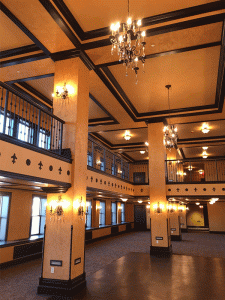
The four remaining, undeveloped floors of the dilapidated hotel are gone and in their place are a grand ballroom and a number of things the theater has been badly in need of, including classrooms, conference rooms, rehearsal rooms, a copy room, a break room and proper office space.
The former offices have been turned into a lounge, a new suite of dressing rooms has been added in the basement and there’s a rooftop terrace overlooking the city.
None of this was easily achieved. Because the Embassy is a historically protected landmark, Weigand Construction couldn’t knock out any walls as it might otherwise have been inclined to do.
Debris had to be carried out in wheelbarrows, and steel beams had to be brought in through windows and maneuvered down long, narrow corridors.
And the theater could not close, said executive director Kelly Updike. The renovations had to be accomplished without disrupting business.
Final cost of the project is $10 million, she said, $8.2 million of which has been raised.
One of the wonders of the grand two-story ballroom, apart from its photogenic staircase, is that it has been made to look like it was created at the same time as the rest of the theater, circa 1926.
“That’s a high compliment,” said the Embassy’s executive director, Kelly Updike. “Moake Park Group is the architect. They are thrilled when people say that, that it looks like it’s always been here.”
The process to create the textured walls required nine laborious coats, she said.
The need for the ballroom went beyond the merely decorative. Before this expansion, one in four people who wanted to rent a portion of the Embassy for a private event had to be turned away because of space or logistical constraints, Updike said.
Now the Embassy will be better able to earn its keep. Updike said this expanded roster of private events should net the Embassy between $100,000 to $150,000 a year. The ballroom is already booked through February 2017, she said. The new rentable spaces will help ensure that the Embassy will never again need to be “saved.”
For the most part, the rooftop terrace will be available for use by people who rent the ballroom.
But there will be a series of Wednesday night summer concerts on the terrace, crowdfunded by Arts United’s Amplify Art!
They start May 25.
“There will be music up here and a portable bar,” Updike said. “People will maybe pay a small cover fee and they’ll be able to come up here and sit.”
There’s really nothing else quite like the rooftop terrace in downtown Fort Wayne and Updike thinks it is spurring some competition.
“I think other people who are building things are saying, ‘Hey, maybe we should do something like that with our rooftop.’”
Two permanent bars were added to the theater lobby via a one-story expansion into an alleyway, she said.
“We owned half of the vacated alley and the parks department owned the other half,” Updike said. “We had to obtain that from them.”
The mobile bars that the Embassy used to use meant that inventory and equipment constantly had to be shifted around.
“It’s nice to have a home for things,” Updike said.
There are new homes for a lot of things in the theater and this has meant that the staff has had to devise new migratory patterns, so to speak. They have had to come up with new workflow paths.
Efforts at the end the last decade to link the new Courtyard By Marriott with the Embassy and the Grand Wayne Center accelerated movement on Indiana Hotel rehabilitation.
The Courtyard’s requirement of a covered walkway to the Indiana Hotel launched other refurbishment plans. If no agreement on the walkway had been reached, the entire Harrison Square project might have collapsed.
For years, Updike said, people looked up and saw four floors of perpetually dark windows. Everyone knew something needed to be done.
In the ‘90s, many of the people who’d helped save the Embassy thought it should almost be a museum, reserved for high culture and closed to the public many more nights than not.
But people have come to understand, Updike said, that the Embassy needs to be a living, breathing thing.
If future generations are going to care about, and care for, the Embassy, they will need to experience it in visceral ways.
Richards said she believes the Embassy’s saviors would approve of what it has become.
“We’ve taken every single inch of this hotel and made it into something that benefits the Embassy Theatre Foundation,” she said.
 aloadofthis