The Beat of a Different Drummer

Standard

Terry Bozzio, one of the world’s premier rock drummers, first learned about the power of music from an instrument that isn’t usually the instigator of many mystical, musical experiences: the accordion.

Bozzio’s father played that instrument in such a way that it changed people’s lives, according to the accordion player’s son.

“My father was a brilliant accordion player and was on stage by the age of four,” he said in a phone interview. “A prodigy. By the time I was a kid and he was in his ‘30s, people would come over to the house and ask him to pull out his accordion. He would always make excuses and say, ‘No, I ain’t got it anymore.’

“Finally, he’d break down and pull the thing out,” Bozzio said. “And he’d play one chord and silence the room. He could make people cry. When you’re a little kid and you see this power of music, it’s a very envious situation.”

Drums came into it for Bozzio the way that drums came into many boys’ lives in the 1950s and 1960s: through the television.

Flashy percussionists like Gene Krupa, Buddy Rich and Lionel Hampton were all over the airwaves in those days. They were exciting to watch and much revered. It should be easy to understand why any boy growing up in the mid-20th century would develop an interest in pounding the skins, Bozzio said.

Or pounding the end tables.

A Tito Puente album purchased by Bozzio’s dad inspired him to transform a set of Heywood-Wakefield nesting tables (tables that fit together like nesting dolls) into bongos.

Bozzio said he still has those nesting tables, but don’t expect him to play them when he appears at GearFest, Sweetwater Sound’s annual showcase of musical technology and the musical technicians that use it.

GearFest happens June 23 and 24 on Sweetwater Sound’s US 30 campus.

Bozzio said it was the Beatles that convinced him to pursue music as a vocation rather than an avocation.

Just as the accordion isn’t the instrument most often associated with acclaimed music careers, it may be that Beatles drummer Ringo Starr isn’t the first person that virtuoso drummers cite as a primary influence.

But Bozzio said Starr’s drumming is underrated.

“I think Ringo was a very creative drummer in feel and with his beat designs,” he said. “He’s a special case because of his fame and influence. But even if I were to listen without that in mind, I would still think he is a very creative drummer. I would cite ‘Ticket to Ride,’ ‘Tomorrow Never Knows’ and ‘Anna’ as examples.”

Throughout his late teens and early ‘20s, Bozzio played mostly for jazz greats such as Joe Henderson, Eddie Henderson, Woody Shaw and Jack DeJohnette.

He also drummed for TV commercial soundtracks and Broadway musicals.

Then Bozzio was chosen over 100 other aspirants to join Frank Zappa’s band.

At 66, Bozzio can still say the Zappa audition was the toughest of his career.

According to the conventional wisdom among musicians at that point, playing with Zappa meant you could play with anyone, he said.

Bozzio said he became world-famous among music professionals and serious music aficionados within a week of being signed by Zappa. Zappa’s reputation conveyed instantaneous veneration.

There is no one who knew Zappa who disputes the following: He was a taskmaster who required perfection and who wasn’t really open to collaboration.

This was fine with Bozzio at the time.

“I always looked at as ‘He’s the director and I’m the actor’ or ‘He’s the conductor and I am the musician in the orchestra,’” he said. “I was happy to have that kind of discipline. I was used to it. I really respected his genius.

“He was ten years older than me and a serious genius in at least ten talents,” Bozzio said. “He was a humorist and a writer. He was a classical composer. He was a bandleader. He was a rock star. He was an arranger. And he was a fantastic guitarist.

“This was a guy who I looked up to,” he said. “I was happy to take his orders and grow from that. It was like marine boot camp for a musician.”

The only disagreement Bozzio had with Zappa was provoked by the latter’s cynicism regarding the music business. Zappa believed a point had been reached where good music could not succeed, financially, on its own merits.

The music business had grown too corrupt, too addicted to bribery and backroom deals.

Bozzio believed at the time that music could achieve grass-roots success.

He eventually came to realize that Zappa had been right all along.

An apt encapsulation, in terms of weirdness and virtuosity, of Bozzio’s years with Zappa can be found on YouTube: a live performance of a song that we must euphemistically refer to here as “Breasts and Beer.”

Bozzio dons a devil mask and adopts a devilish persona during the segment.

Bozzio’s departure from Zappa’s band was like a father bird pushing a baby bird out of the nest, he said.

“He took me aside and said, ‘Bozzio, I think it’s time you go off and do your own thing. I don’t think you want to do this anymore.’ And I said the same thing I’d said when he offered me the job: ‘Do you really think I can do this?’”

Two years later, Bozzio founded (with his then-wife, Dale) the eighties pop group Missing Persons.

Thanks to catchy tunes and a sexy singer, the band was hugely successful. But it also benefitted from debuting at roughly the same time as MTV.

In the beginning, MTV depended on those rare acts that had shot promotional videos for some unknown reason and Missing Persons was one of those acts.

“We were on heavy rotation because MTV only had three videos,” Bozzio said, laughing.

The end of the band coincided with, and was inextricably linked to, the end of the Bozzios‘ marriage.

In the years immediately after the dissolution of Missing Persons, Bozzio said he tried to remake himself into a pop soloist in the vein of Phil Collins.

But it didn’t feel natural.

He began to think in terms of “orchestral drumming,” featuring a drum set tuned in such a way that it could sound like an ensemble.

Nowadays, Bozzio tours the world giving solo drum concerts on his “big kit.” According to a 2014 article in the Cleveland Plain Dealer, the big kit consists of “26 toms, two snares, eight bass drums, 53 cymbals (including a ride gong), 22 pedals (which operate five hi-hats, a djembe, a foot cymbal, a jingle stick, rik, a tambourine, a foot tom, two ‘metal things’ and a foot gong), a xylophone, a glockenspiel, chromatic gongs, a ‘big’ gong, two electronic drums and miscellaneous percussion…”

The big kit won’t be making the trip to Fort Wayne, alas. Bozzio has a smaller version that he takes to clinics and workshops.

Bozzio said his solo drum tours do extremely well everywhere in the world but the United States.

Or the “culturally bankrupt United States,” as he puts it.

“I look to Europe and Japan, which are way more culturally open minded and have nice places to play,” he said. “Music seems to be something that’s a little more treasured there.

“I don’t blame the American people,” Bozzio said. “I blame dropping music in the schools and devaluing music completely. We’re all battling this.”

The Word On the Street is Buskerfest

Standard

Launching an event called Buskerfest was a brave thing to do in Fort Wayne in 2009.

Busking, both the word and the practice, was virtually unknown in the Summit City eight years ago.

It is safe to say that many of the people who came out to celebrate busking (aka street performing) that year weren’t entirely sure what they were celebrating.

Yet Buskerfest has endured.

It survived a derecho in 2012 and what many of us in 2015 referred to as the mini-derecho, even though it infuriated meteorologists of our acquaintance.

Neither hail nor sleet nor heat nor gloom of dusk stays these acrobats from the swift completion of their appointed flips.

The 2017 edition of Buskerfest happens June 29.

Rick Zolman, events and programming manager for the Downtown Improvement District, wants to highlight two national acts that are visiting the event for the first time this year.

One is the Adorkable Derek, a guy who combines pole acrobatics (aka pole dancing sans salacious connotations) with the comedic sensibilities of a young Jerry Lewis.

Watch videos of him on YouTube and you will see him undergo a transformation reminiscent of a nutty professor: nerd to hottie.

“Derek hails from Los Angeles, California,” Zolman said. “He is a funny combination of pole acrobatics, audience participation nerdy dancing and, of course, a love story. He doesn’t talk while he is doing this. So it’ll be interesting to see how he performs.”

The other is the Boston-based Cate Great, who combines circus skills, stand-up and performance art.

Great makes use of a rolla bolla board, according to Zollman. Rolla bolla boards are those boards that circus performers put tubes under and surf atop.

“She does some gravity-defying stuff,” he said, “and then she stands on her hands toward the end of the act and goes from two hands to one while she is on stilts. It’s amazing.”

Seven nationally and internationally renowned buskers will perform on or at the Busker Central Pitch, which is the name of the Buskerfest main stage.

A “pitch” is busker terminology for a performance space or spot. It’s the place where a busker makes his or her pitch to a prospective audience.

Busker Central Pitch will be located at the intersection of Wayne and Calhoun, Zollman said.

Thanks to technology introduced last year, the main stage performers will have help making their pitches.

The elevated Jumbotron screen that debuted in 2016 will return, Zollman said.

The Jumbotron screen allows attendees to do and see more things, he said.

Much “organic busking” will be happening at the event as well, Zollman said.

Organic busking is Zollman’s term for the sort of busking that happens daily on the streets and sidewalks (and in the subways) of cities around the world.

Zollman predicts that there will be no less than 30 strolling performers at Buskerfest this year: living statues, historical reenactors, jugglers, mimes, fine artists and musicians.

Local music will have its own Loud & Local Pitch again this year. Scheduled acts include G-Money, the Gregg Bender Band, Elle/The Remnant, Silbo Gomero and the Jug Huffers.

A collection of local food trucks (known for their successful cuisine pitches) will be on site, hamming it up (perhaps with actual ham).


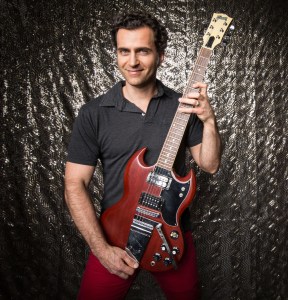
Dweezil Zappa: Son of Invention

Standard

It is not uncommon for famous musicians to try to dissuade their kids from getting into the family business.

Frank Zappa went in the other direction, according to his son, Dweezil.

“He put ‘musician’ on my birth certificate where it said ‘religion,’” Dweezil Zappa recalled in a phone interview. “He already had some indication that I was going to take that path.”

On June 23 and 24, Dweezil will have taken a path to GearFest.

Even if you hadn’t seen the term GearFest before encountering it here, you were probably able to discern that it refers to a celebration of gear.

“But what kind of gear?” you may be thinking. If your guess is “fishing equipment” and your nickname isn’t “the fishin’ musician,” Sweetwater Sound’s GearFest may not be for you.

Gear in this instance means the tools for crafting and polishing music – the very tools that Sweetwater Sound sells around the world.

GearFest attracts between 10,000 and 15,000 attendees to Sweetwater Sound’s sprawling complex on U.S. 30 every year. They come to take in and partake of gear-centric exhibits, seminars, clinics, workshops, panels and performances.

It is free and open to the public.

Dweezil will be conducting a workshop sponsored by D’Addario guitar strings. Other celebs on site will include guitarist Eric Johnson, drummer Terry Bozzio, guitarist Andy Timmons, record producer Fab Dupont, drummer Omar Hakim, keyboardist Larry Dunn and drummer Mike Mangini.

For more than a decade now, Dweezil has been touring with a show called (for most of that span) “Zappa Plays Zappa.”

It is a showcase of Frank Zappa’s music, commandeered and performed by someone who knows as much about it as anybody and likely cares more.

Dweezil launched Zappa Plays Zappa partly because the people who were playing his dad’s music at the time were playing it wrong.

Frank was notoriously persnickety and imperious about his compositions, and he had a spiel for members of his band who had started to showboat.

“At a certain point, somebody would think they needed some star time,” Dweezil said. “They would try to start changing parts to draw attention to themselves. And that would be the point at which my father would say to them, ‘Window or aisle? How would you like to return home?’”

Dweezil needed two years of guitar retraining before he felt he could do justice in concert to his dad’s excellence on that instrument.

Another motivation for the creation of Zappa Plays Zappa was concern about his father’s legacy. Dweezil felt that young people really didn’t know much about his father beyond a couple of novelty tunes and his distinctive face.

These days, Frank Zappa’s legacy is under attack from an unexpected quarter: sibling rivalry.

After Dweezil’s mother died in 2015, his brother and sister, Ahmet and Diva, began to take legal steps to limit what Dweezil could do with Frank’s music.

Dweezil said he was was told that he couldn’t use the title “Zappa Plays Zappa” anymore and his suggested substitute, “Dweezil Zappa Plays the Music of Frank Zappa,” was rejected.

So he changed the name of the show to “Dweezil Zappa Plays Whatever Plays the (Expletive) He Wants — the Cease-and-Desist Tour.”

Dweezil said Ahmet and Diva have filed for a federal trademark to gain exclusive use of “Zappa.” If approved, it could block Dweezil from using his own last name professionally.

“We are still in the discovery phase of all that,” he said. “Lawyers back and forth. Meanwhile, they could easily stop any of that by saying, ‘If we get this trademark, we will not block you.’ They refuse to sign any document saying that.”

“At the same time,” he said, “they are telling the public, ‘We would never block him!”

Ahmet has told the press that he is willing to let Dweezil use “Zappa Plays Zappa” for a nominal fee of $1 a year, but what he doesn’t say (according to Dweezil) if that he wants 100 percent of profits from the sale of merchandise.

“Nobody would ever take that deal,” Dweezil said. “They don’t pay any of the costs related to the tour: the salaries, the travel.”

Dweezil claims Ahmet and Diva, who share a controlling interest in the Zappa Family Trust, plan to use Frank’s name and image to sell products he never would have endorsed when alive: yoga pants, for example.

“They have already put out the yoga pants with Frank’s name on them,” he said. “Why is it that Diva Zappa can make yoga pants with Frank’s name and image on them and I can’t say that I am playing Frank’s music?”

The irony here, in Dweezil’s estimation, is that he is the only one involved in this imbroglio who actually has a proven record of trying to preserve and extend his dad’s creative legacy.

Dweezil believes the law is on his side in a number of respects.

Some of the fallout from all of this is fan confusion, Dweezil said.

“It rubs (fans) the wrong way,” he said. “And then it also creates a certain element of people deciding to choose sides. Rather than unifying the family and saying, ‘Let’s make this the best possible version of the family legacy,’ they are creating this divide for no reason.”

Whatever that outcome of this, it seems apparent that Dweezil becomes more like his father with each passing year: more ambitious, more experimental, more multidimensional.

In March, Dweezil released a track to help raise funds for legal fees called “Dinosaur.”

It was assembled using a method his father dubbed “xenochrony.” Xenochrony creates a coherent pastiche out of related and unrelated snippets.

“Dinosaur” combines solos from nine guitarists including Frank Zappa.

Dweezil has a larger xenochrony-related project that he has been working on for more than two decades called “The Hell Was I Thinking.”

It is a massive guitar instrumental that currently features the work of roughly 40 guitarists.

“One of the big goals with that one too is to mix it in surround sound because I see it as an audio movie,” Dweezil said, “and I’d like it make it a completely three-dimensional experience.”

Dweezil is also taking his first stab at composing classical music. The finished result is scheduled to be performed by a 100-piece Dutch orchestra at the end of the year.

“If you had told me 12 years ago that one day I’d be writing orchestral music to be performed, I would have said, ‘What are you talking about?’”

Even as he expands his creative horizons, Dweezil knows that there will never be another self-taught polymath like Frank Zappa.

“He had the idea that you could put anything with anything for any reason at all,” Dweezil said. “There weren’t any boundaries. He was fearless in that way. The key to it was that he was an auteur who could do everything required to bring an idea to fruition. He didn’t have to rely on other people to bring an idea to fruition. He just needed to hire people to play a role and execute the part.”


Junifest

Standard

Fort Wayne’s first Germanfest, which happened in 1981, was surely an attempt to educate people with no naturally occurring German heritage about German culture.

That was 36 years ago. Germanfest long ago outgrew its humble origins and Hoosiers long ago outgrew their humble ignorance of German culture.

The 2017 edition of the festival starts June 4.

German culture is now such an ingrained part of Indiana culture that most Hoosiers probably don’t even realize what’s German and what isn’t, according to Germanfest’s treasurer and marketing director Bob Anweiler.

The unpretentious entrée most closely associated with the state, the pork tenderloin, is merely the German schnitzel or Wienerschnitzel in Midwestern disguise, he said. And many roast pork recipes owe a debt to German Schweinebraten.

Most Hoosiers grill “brats” all summer without once acknowledging their German origin, Anweiler said. Bratwurst is just one of about 1500 different types of German sausage. And there are more than 40 bratwurst recipes unique to more than 40 German regions.

As if this all weren’t surprising enough to some people, none of those aforementioned German regions is named “Stadium,” despite what it says on your package of supermarket brats.

It might be that 2017 is the perfect year for some more education.

A good way to expand your brat palate (one of the most important of all the palates) is to attend Köstritzer Night at Club Soda on June 5.

The Köstritzer of the title refers to Köstritzer Schwarzbier, a black lager produced by the Köstritzer Brewery near our sister city, Gera.

The oldest American breweries brag about having been founded in the mid-19th century.

That’s impressive until you find out that the Köstritzer Brewery is one year away from turning 475.

Köstritzer Schwarzbier confuses folks who are used to (and are used to avoiding) Irish stout. Yes, it is dark, but its taste is relatively light and clean.

It is a beer that is well paired with the Thüringer Rostbratwurst. The oldest known written reference to the recipe for this sausage was made in 1404, 139 years before the founding of the Köstritzer Brewery.

In other words, this is no fly-by-night nosh.

Believe it or not, Anweiler had to be kind of sneaky about getting out of Germany with the recipe. A police captain was recruited for the mission.

The whole story would make a great spy novel: “The Bourne Rostbratwurst.”

Food and drink has always been and will always be a huge part of Germanfest, of course.

Hundreds of gallons of homemade German potato salad and sauerkraut will be served during the festival, according to Germanfest president Ken Scheibenberger.

Massive quantities of kraut balls, kuchen (cake), handcrafted brats and currywurst (sausage with curry ketchup) will be sold.

Hundreds of kegs of Köstritzer and Hofbräu Original (a blond lager) will be quaffed, Anweiler said.

Yuengling beer will make its debut at Germanfest this year as well, he said.

Because there are many components to the festival in addition to the Headwaters Park component, there is always some confusion.

While Germanfest events begin to happen around the city on June 4, the opening of the Headwaters Park festival “tent” doesn’t happen until June 7.

This is the way things have been done for decades. That hasn’t prevented people from showing up at Headwaters Park on any of the four days before the opening of the festival tent or on the Sunday after its closing, Anweiler said.

“The main festival tent downtown is Wednesday, Thursday, Friday and Saturday,” he said. “Sunday is kind of the recovery day when you go to church and ask for forgiveness.

“Invariably, on that second Sunday, we have people showing up as we’re cleaning up,” Anweiler said. “And invariably, on that first Sunday, we have people coming down.”

The events that happen outside Headwaters Park are always well attended but Anweiler would still like to see more people at those.

“Especially the club night events,” he said, referring to Köstritzer Night at Club Soda and Hofbräu Night at the Fort Wayne Sports Club.

Schedules and information about such events as a wiener dog race, a sausage-stuffing contest, a beer-based test of strength, a polka lesson, a grape stomp, a beer and wine tasting, a choral concert, a German dinner and a beauty-in-lederhosen pageant can be found at Germanfest.org.

There was a time when there were only three summer festivals of consequence in Fort Wayne: Germanfest, the Greek Festival (aka Greekfest) and the Three Rivers Festival.

Nowadays, major and soon-to-be-major events happen on both sides of Headwaters Park through the end of September.

But Germanfest is first and will likely always be first. It launches a season of summer fun in Fort Wayne.

“We just have this really good environment for people to come down,” Anweiler said. “We always hope we have nice weather. It’s probably the first nice weather that people are able to enjoy where they aren’t worrying about it getting cold out.

“It’s a great way to start the season off,” he said.