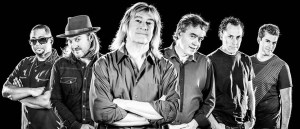
Rocking the Foundations

Standard

If you are no contemporary Christian music expert, you might conclude that much of the genre consists of slick, sonically safe pop-rock .

This may be an unfair assessment, but it would be hard to dispute the breath of fresh air that the Union of Sinners and Saints brought to this musical genus in 2016.

The band performs at C2G Music Hall on August 5.

The Union of Sinners and Saints is all kinds of improbable. First of all, it owes some of its freshness to nostalgia. The band’s beefy sound is hugely evocative of such arena rock stalwarts as Journey, Asia, Def Leppard and Bon Jovi.

Secondly, the band is a bona fide supergroup uniting members of two of Christian rock’s greatest defunct acts: Petra and Whiteheart.

Guitarist and vocalist Billy Smiley, one of the founders of Whiteheart, said he got the idea for forming a supergroup while watching a performance by the Hollywood Vampires.

The Hollywood Vampires is a supergroup that arose in 2015 from the unlikely (and, perhaps, unholy) union of Alice Cooper, Aerosmith’s Joe Perry and actor Johnny Depp.

Smiley approached former Petra vocalist John Schlitt at a convention and pitched the idea of combining the sensibilities of (and some of the musicians from) Petra and Whiteheart into a new musical entity.

“And so we said, “That would be kind of cool: Grabbing all the Whiteheart fans and grabbing Petra fans and kind of doing something fun,’” Smiley recalled. “When we did the record, the whole purpose was to have a great time and see what energy developed.”

Smiley wanted to make the best use of Schlitt’s vocal power.

“He’s got a very unique voice,” he said. “We really tried to combine the high points of each group. Three of the guys in the group are from Whiteheart.”

Each concert by the band tends to consist of “six Whiteheart songs, six Petra songs and six new ones,” Smiley said.

Given the long histories and amassed fan bases of both bands, Smiley said he is seeing a wide range of enthusiasts in the audience.

“Especially from 35 to 70,” he said, “but a lot of those people are bringing their kids to show them the music they grew up with.”

The band has been touring for a year, but the Fort Wayne show promises to be special.

Both Petra and Whiteheart have Fort Wayne roots.

Petra was formed in 1972 by students of a now-shuttered Fort Wayne bible school.

And one of Whiteheart’s founding members and main songwriters, Mark Gersmehl, was born in Fort Wayne in 1954.

“For that Fort Wayne show, I bet we’ll see people from Illinois and Michigan and Ohio,” Smiley said.

Smiley said the name of the band came out of a brainstorming session.

“The Union of Sinners and Saints had a real ring to it,” he said. “It really said exactly what we wanted to do and be. The union of taking people who need God. It was a perfect title and it was available. Can you believe it?”

Given the state of the music industry these days, The Union of Sinners and Saints isn’t likely ever to be a huge moneymaking venture for anyone involved, Smiley said.

“Our goal is just to keep doing music, keep doing what we love and to do it right,” he said. “We want to honor fans of Whiteheart and Petra and that means doing it right.”

Gizzae Has Got To Keep On Moving

Standard

Brian Rock, aka “Rocket,” came to New York City from the island of Dominica in the mid-1970s as the bassist and lead singer in a reggae band. He was only 16 years old.

The temperature in Dominica rarely deviates from the ‘70s and ‘80s year round. So when that first New York winter hit, Rock said he cried and wanted to go back home.

“From a small island – we have 70,000 people in Dominica – and you move into the biggest city in the world, it was a shock,” he said. “But I knew I was here for music. Music always made me happy.”

Four decades later, Rock heads up a band called Gizzae that has been serving most of Chicago’s reggae needs since 1992.

Gizzae performs at the Foellinger Freimann Botanical Conservatory on August 4 as part of the conservatory’s Botanical Roots series.

Reggae is the music of Jamaica, but “gizzae” is not a Jamaican Creole term. Gizzae means “time” in Amharic, the official language of Ethiopia, Rock said.

“Two guys in the band are from Ethiopia,” he said. “(So Gizzae) is like a metronome. We are music. We are time.

“We also like to be on time,” Rock said, laughing. “I know reggae musicians have a bad rep, I think.”

Rock grew up listening to the music of the Caribbean, of course, but it wasn’t calypso or reggae that impelled him to become a musician. It was the documentary film, “Woodstock.”

“When that movie came out – Jimi Hendrix, Santana, big stars – you soon started to hear a lot of rock music on the radio,” he said. “So I started playing rock music on the islands. That was what started the ball rolling for me personally. That movie changed by life.”

The origin of Rock’s nickname, Rocky, isn’t hard to deduce. Rock said everyone who grows up in Dominica gets a nickname and that becomes the name they’re known by.

“Whenever anybody called me Brian,” he said, “I thought they were teasing me.”

Reggae was what brought Rock to New York City, but it wasn’t the only music that he played in New York City.

One day, he was asked to visit a studio where a singer-songwriter was working on an album.

The singer-songwriter, a stranger to Rock, was unhappy with a bass line that had been laid down for one of his songs and wanted to see if Rock could play something better.

Rock could and did.

A year later, Rock was watching TV and saw the singer-songwriter he’d helped out.

It was Bruce Springsteen.

The song Rock had played on was “Cover Me,” from the album “Born in the U.S.A.”

“I didn’t know who Bruce Springsteen was,” he said, laughing. “It might have been a good thing because I wasn’t intimidated.”

Rock’s collaboration with Springsteen lead to later session work on “Too Much Blood,” a song from the Rolling Stones album, “Undercover.”

Rock eventually tired of New York City and looked for other cities in which to live and work.

He tried Miami and Los Angeles, but they weren’t for him.

Ultimately, Rock settled on Chicago.

“Chicago’s music scene is so cool,” he said. “There’s so much live music and you can actually survive as a musician.”

Gizzae rose from the ashes of one of Ziggy Marley’s former backing bands, Rock said.

The band needed a bass player and Rock, who had just arrived in Chicago, said he “was only too happy to do it.”

Rock inherited vocal duties when Gizzae’s original vocalist was late for a rehearsal and Rock had to step in.

“I was singing and playing,” he said. “And when the singer came and he saw me doing that, he was like, ‘Oh man…’”

“He just quit after that,” Rock said, laughing.

The eventual success of Gizzae helped Rock in ways he couldn’t have predicted when he joined the band.

When Rock’s wife died of cancer, he became a single parent to his young sons. His performance schedule allowed him to be home during the day with his boys. Other relatives were able to take over at night.

Now those boys, Isaiah and Mosiah, are grown and are accomplished musicians in their own right.

Mosiah works as a music producer and engineer, Rock said, and Isaiah recently graduated from college with a teaching degree.

For the time being, however, Isaiah is eschewing the classroom for the stage.

He is on tour with Gizzae this summer.

“He told me, ‘I am going to take a year off and be a musician before I get a real job,’” Rock said.

With his sons out and on their own and Gizzae’s Windy City legacy assured, Rock has begun to fulfill his last big dream.

He is building a club and recording studio in Dominica where he hopes to teach young citizens the ins, outs, ups and downs of the music business.

“I have been here 42 years now,” he said. “I decided it was time to move back. I want to work with kids and show them how it’s done. How to entertain.

“I have spent most of my life on stage,” Rock said. “All I want to do now is to give back. That’s what life is about. You get and then you give back.”

Barenaked Necessities

Standard

Unlike many bands, Barenaked Ladies actually relishes the moments in concert when things don’t go exactly as planned, according to guitarist and lead singer Ed Robertson.

“We’re always ready to stray from the set list and embark on a strange musical journey,” Robertson wrote in an email interview. “To me, that’s what makes the shows unique, and challenging…(it’s) the moments of improv that I live for. It’s a tightrope walk that is so fun and challenging.”

No two tours are ever the same and no two concerts are ever the same, he said.

“Every BNL show is a new experience,” Robertson said. “We leave a lot of room for spontaneity, and improv. We always try to play the songs that people want to hear, and throw in a few off the beaten path, but there are ALWAYS new moments in every show.”

Barenaked Ladies perform July 23 at the Foellinger Theatre.

There have been two distinct phases in the life span of Barenaked Ladies: The Steven Page Period and the Post-Steven Page Period.

In 2009, lead singer and band co-founder Page left Barenaked Ladies in the wake of a drug-related arrest.

Despite the most obvious controversy swirling about at the time, Robertson has said that Page’s leave-taking was not attributable to any single factor.

A lead singer’s exit can be pretty rough on a popular band because departing lead singers tend to take a lot of a band’s signature sound with them.

The remaining members of Barenaked Ladies were anxious about how Page’s absence would be processed by the fans, but Robertson said they took it in stride.

Both Page and Barenaked Ladies went on to produce critically acclaimed new music, so there were happy endings all around.

Over it’s three-decade existence, this Canadian band has moved more than 14 million units (aka “sold albums”), won eight Canadian Grammies (aka Junos) and provided the theme for the hit TV show, “The Big Bang Theory.”

The latter accomplishment might have earned it as many detractors as admirers, but let’s not explore that.

The band’s biggest hits (“If I Had a Million Dollars” and “One Week”) are quirky and lightweight – lyrically dexterous but goofy.

But Robertson said there are serious moments on stage as well: The song “Moonstone,” for example, which is about his mother.

Even when the band is playing silly songs, Robertson said, the musicianship is serious.

The band enjoys challenging itself. It added an acoustic set to dates on last year’s tour and it recently participated in an album-length collaboration with The Persuasions, a Brooklyn-based a capella group that first formed in the 1960s.

The two groups met at Lou Reed tribute show and hit it off. They subsequently moved with alacrity into a studio to see what would develop.

What developed were 15 tracks in a day and a half, Robertson said.

“I thought we were going to get 3 to 4 songs done,” he said. “It was one of the easiest recording projects we’ve ever done…(it) was such a pleasure to collaborate with those guys. They really dug in to the songs, and had fun with the arrangements. It was a blast. I’m super proud of that record.”

Allmusic.com called the resulting record (“Ladies and Gentlemen: Barenaked Ladies & the Persuasions”) one of “the more unexpected but utterly likable Barenaked Ladies releases.”

Barenaked Ladies hits covered on the album “are broadened and given added poignancy by the framework of the Persuasions’ deep harmonizations,” according to the review. The album works “because of the sheer joy and immense talent on display by both groups.”

Robertson said that his only goal for himself and his fellow band mates at this point is to find new challenges – the sort of challenges that are entertaining for fans, of course.

“Is that a crazy goal?” he said. “I would pay to get to play the shows we get paid to do. It’s an incredibly fortunate position to be in, and I don’t take it for granted.”

Robertson didn’t say so explicitly, but other of his personal goals must surely involve “playing the silver ball,” as Pete Townshend wrote.

He has become known far and wide as a pinball aficionado – a collector, restorer and player of vintage pinball machines.

On tour, Robertson said he usually goes off on pinball-related side trips to visit like-minded collectors and dealers.

He said the connection between pinball and music is more obvious than it might seem.

“Pinball is rock and roll under glass,” he said, “so the connection is pretty immediate. It’s lights and sound. Kinetic energy. Structure and chaos mixed. I can’t get enough of either!”

Robertson believes playing pinball actually improves his cognitive functions.

“The challenge of the physicality of the machine mixed with the complexity of the rule set is a great mental work out,” he said.