
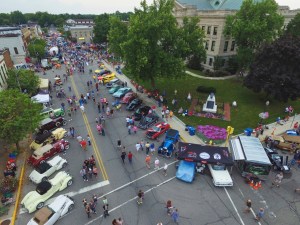
Amber Jackson has been the executive director of the Auburn Cord Duesenberg Festival for about eight months and she is still learning the ropes.
The “ropes” in this instance consist of a classic car festival that has been in existence more than 60 years and sees the influx of hundreds of thousands of global automotive enthusiasts every Labor Day weekend.
Aussies have been known to ship their cars to this thing. It’s a big deal.
People who know Jackson (as I do) will tell you that she’s smart, fearless, gregarious, earthy, approachable and impossible to dislike.
What she is not is an Auburn native.
A couple of things have surprised her about the festival so far.
For one thing, she didn’t expect that the festival would engender such a profound depth of feeling among Auburn residents.
“That’s the big kicker,” she said. “It’s not, ‘Can I do this job?’ or ‘Can I do it well?’ This event means so much to this town. It’s their baby, it’s their son, it’s their daughter, it’s their grandkids it’s their grandparents. It means so much to so many people.
“So I think when I realized that,” Jackson said, “the weight of what this means to the community, it bore an extra responsibility. I thought, ‘I really have to do my best to make this come together and to grow in the right ways.’”
In the early 20th century, Auburn was the home of the Auburn Automobile Company, where Auburn, Cord and Duesenberg automobiles were built.
The Great Depression claimed roughly half of the American automakers that had existed prior to Black Friday, including (eventually) the Auburn Automobile Company.
In 1956, the ACD Club was formed. The ACD Festival grew out of what was, at first, an exceedingly modest parade of club members’ cars.
These days, the Saturday Parade of Classics should feature as many as 300 restored Auburns, Cords and Duesenbergs and the Friday Cruise In should feature no fewer than 700 classic cars of myriad makes and models.
When she first started in the job, Jackson said she wondered how she was going to be able to pull everything together.
The answer, as it turned out, is that no one expected her to pull everything together. Not all by herself, anyway. The ACD Fest is nothing if not a group effort. It’s a well-oiled machine that just happens to tout well-oiled machines.
“Honestly, it’s been amazing because this thing is starting to come together like a symphony,” Jackson said. “At first, it’s all jumbled and it’s everywhere and I’m like, ‘I don’t understand how this all pieces together. There are over 50 events in the span of a week.’ You look at that scope and you think, ‘This is chaos.’”
But Jackson said she’s been awestruck watching the graceful convergence of these components and she’s been impressed with the passion and sincerity of the people with whom she has collaborated.
“I am not an Auburn girl,” she said. “Everybody I have had the pleasure of working with thus far has a community-before- capital mentality. It’s just amazing to me.”
A major addition to the festival this year is a headlining musical act: country singer James Otto.
Otto, who will perform September 2, is a member of the MuzikMafia, a collection of like-minded country upstarts that also includes Big & Rich and Gretchen Wilson.
The 2017 edition of the festival will also see the return of Fast & Fabulous in Downtown Auburn, a popular recent innovation that features such modern luxury cars as Ferraris, Lamborghinis and McLarens.
One of more vexing challenges for the ACD Fest (and all long-lived festivals, honestly) is figuring out how to attract young people to the goings-on.
Jackson, whose background is in education, said the kids’ area will be much expanded this year.
“Our board sees a lot of growth with that area,” she said. “How do we get kids to fall in love with classics? Anything that’s loud and fast, they’re naturally going to be drawn to. But that’s not the nature of a classic.”
In the future, she said, the festival’s education program will be significantly beefed up.
NATMUS, the National Automotive & Truck Museum in Auburn, offers classes in car restoration to high school students, she said.
“A bunch of volunteers come and work with the kids on actually restoring cars that have been donated to them,” Jackson said. “The festival is the gate of exposure. But what the town does the rest of the year really opens it up for what that longevity is really going to look like.”
A longtime fan of the festival, Jackson has a theatrical analogy to describe the position in which she finds herself at the moment: “I went from sitting in the balcony of the second show to being backstage, directing,” she said.
Being the rookie in such a scenario would scare a lot of people, but Jackson said she loves it. She thinks it will help her see what needs to be done to attract more young people and women to the festival.
“I would love to go sit in with the high school kids on the car restoration classes,” she said. “I came from an old school mentality where my dad had speckled, gold, ’79 Charger in the driveway and when I tried to help him work on it, he said, ‘You don’t have to worry about this. You’ll have a husband do that for you one day.’”
Jackson said she has succeeded in business up to now because she has gone in with the perspective of an educator, not of an accountant.
“I don’t go in looking at a bottom line,” she said. “I go in looking at it from an education standpoint: Where are the areas for growth? How can this be connected to people? How can we translate this into real-world experiences?”
 aloadofthis