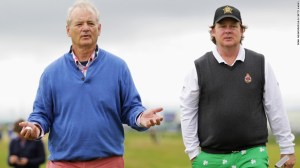
All New Cheap Moves: The Unlikely Career of Joel Murray

Standard

Joel Murray is the youngest member of “the Chicago Murrays,” a phrase that sounds like it could only describe royalty or the mafia.

It may be a little of both in this case: Murray’s older siblings include Brian Doyle Murray and Bill Murray, two men who are as revered for their mischief as they are for their art.

Joel Murray will perform with Ryan Stiles, Jeff Davis and Gregg Proops as part of “Whose Live Anyway,” a night of improv comedy at the Embassy Theatre on September 21.

The “Whose Live Anyway” tour is a spin-off of “Whose Line is it Anyway?” – a 30-year, international, TV and radio tradition in which Murray has never participated.

Murray, a seasoned improv comic and character actor, was recruited for the live tour by his friend, Stiles.

He replaced Chip Esten, who left the tour five years ago to star in the TV series “Nashville.”

Murray grew up with nascent celebrities who were cutting their teeth on the Windy City improv scene, so it isn’t surprising to learn that he eventually distinguished himself on that same scene.

What may surprise is the discovery that Murray owes his entire career to a night he spent in Fort Wayne in the early 1980s.

How it happened was that Murray was sitting in a Chicago bar with his friend David Pasquesi, who currently plays Julia Louis-Dreyfus’ ex-husband on “Veep.”

They started chatting up two women who revealed that they had a sketch comedy performance the following night and that they really didn’t know as much about sketch comedy as two women in their situation should know.

Even though both men, especially Pasquesi, would one day come to be known as some of this country’s best improv comics, they may have known even less at that time about the topic than the women did.

But they pretended that they were experts, as single men in bars tend to do.

“What Pasquesi and I did was lie outright,” Murray recalled. “We said, ‘Yeah, that’s what we do. We do sketch comedy.’ So these girls wrote us into their sketches and we wrote a couple of things.”

Thus it was that Murray and Pasquesi found themselves in Fort Wayne the next evening, performing eight minutes’ worth of sketch comedy on Night Shift, a long-running local talk show hosted by comedian Kevin Ferguson.

After they returned to Chicago, Murray and Pasquesi enrolled in a class taught by Chicago improv legend, Del Close.

Close told them to improvise something based on the over-the-counter menstrual drug, Midol, and the duo recalled a sketch they’d performed in Fort Wayne that involved rifling through a woman’s purse.

“It was really slow, hungover comedy and Del Close went nuts for us,” Murray said. “Afterwards, he said, ‘I really enjoyed what you guys did up there. Your brothers have been very good to me over the years. So I am going to give you a scholarship to study here.’

“Then he goes, ‘But I really enjoyed that Pasquesi, so I am going to give you both a half-scholarship.”

Murray was off and (half) running. He said he had his appearance on “Night Shift” on his resume for many years.

Murray has had an interesting and diverse career. He was a regular on the sitcoms “Love & War” and “Dharma and Greg,” then went on to more dramatic stints in shows like “Mad Men” and “Shameless.”

“’You’ve had a wonderful life after all,’” Murray said, spoofing Christmas angel Clarence Oddbody. “It’s easy to get pigeonholed in this town: ‘Oh, he’s just a sitcom guy.’ And then someone takes a chance on you and all of a sudden you’re a dramatic actor and people forgot you ever did comedy.”

Going into show business was not a foregone conclusion for the all of the nine children sired by Murray’s dad, lumber salesman Edward Joseph Murray II.

Only four went on to pursue comedy and acting. One became an Adrian Dominican nun.

Comedy ensued in the Murray household because Murray’s dad was a slow eater.

“We would eat in 45 seconds and he would take an hour,” Murray said. “We weren’t allowed to leave the table until he was finished so our goal was to make him laugh with milk in his mouth.”

Murray learned a lot about comic timing bantering with his siblings.

“It was handy that you had the funniest people in the world around,” he said. “It was an interesting place to grow up. You learn about a lot of things when you grow up in a three-bedroom house with 11 people.”

Being Bill Murray’s younger brother means that you get asked a lot about the most famous of the Chicago Murrays.

Bill Murray has almost been deified by his fan base. They seem to see him as a pixie or sprite who goes around making the world a better place by way of enchanted non sequiturs and bursts of magical randomness.

“It is fascinating,” Murray said. “The mystique is good since I am in business with him on a clothing line. We’re all for the mystique.”

Murray said he’ll always think of Bill as “the goofy long-haired guy with the Fu Manchu who walked the dog 20 miles one day.”

“He’ll always be goofy Billy in my mind, a little bit,” he said. “People treat him like he’s the oracle – everything he says is right. You know, in retrospect, half the time he’s wrong. But he is an amazing guy. He’s an amazing judge of character.”

Murray said some of the best times of his life were spent with his brother.

“He can bring a room from zero to 100,” he said. “He can also bring a room from 100 to zero, depending on his mood. He does have a way of bringing a weird energy that changes everything.”

Murray recalled a night he spent with his brother at a karaoke club in Venice, Italy that ended with Bill pinwheeling the wives of Japanese executives on the dance floor.

“Billy gets out there and sings ‘Sukiyaki’ for this crowd of Sanyo executives and he knows all the words in Japanese,” he said. “They’re singing along with him and laughing. At the end of it, this woman comes up to hug him and he picks her up – of course; he loves to pick people up – and turns her upside down and shows everybody her underwear.

“The next thing you know,” Murray said, “all these Japanese men look at their wives like, ‘Go on. Get in line.’ All of a sudden, there’s a line of 20 Japanese women asking to have their underwear shown to the crowd.”

As the Murrays left, the ecstatic owner of the embellishment kept handing them random items from around the club as parting gifts.

“We’re walking out with products and I said, ‘That was the weirdest thing I have ever seen.’”

When Murray watched his brother in “Lost in Translation” for the first time, he had a unique insight into a certain scene.

“I could tell by the look on (Bill’s) face what happened,” he said. “He’s by himself and he’s on this beautiful golf course and he hits this beautiful drive and he just starts walking. And I said to him, ‘You left at that point, didn’t you?’

“And he said, ‘Yeah. The drive was phenomenal,’” Murray said. “It just kept going and going. I just went and played the round of golf.’ He just gave this look to the Japanese film crew like, ‘Hey. You gotta play that one, right?’ And he left.”

 

He Sure Don’t Want To Hurt No One: The Mellowing of Steve Miller

Standard

On August 23, one of the most momentous rock music events of the 21st century occurred.

Steve Miller posted a personal video message on Facebook.

If that doesn’t seem all that momentous to you, perhaps you don’t know Miller.

Miller is one of rock music’s more reclusive geniuses. He declines most interviews and is, by many accounts, a bit of a curmudgeon.

So this personal message, telling fans to look out for a new retrospective recording, came as something of a shock.

The Steve Miller Band comes to the Foellinger Theatre on September 20.

Reached by phone, Kenny Lee Lewis – Miller’s bassist and one of the band’s songwriters – said he understands fans’ astonishment.

Lewis explained that Miller’s fourth wife Janice appears to be having a mellowing effect on him.

“His new wife is really working hard to get his brand a little more out there,” Lewis said,” and trying to get him to interact with his audience more.”

Lewis knows all about wives who know best.

On two occasions in his musical career, Miller asked Lewis to drop everything and join him on the road and Lewis, nudged by his wife, decided to drop everything both times.

The first time, Lewis was cultivating a respectable solo career and the second time, he was making good money designing and selling musical equipment.

Music fans assume these decisions are no-brainers, but there are mitigating factors to consider, Lewis said.

Like dental insurance.

“When you went on the road back then,” he said, “you sort of had to tell everyone else, ‘Sorry, but I am not going to be available.’ You had to turn down a lot of clients and a lot of work.”

Lewis’ first encounter with Miller happened in the early 1980s.

Lewis, guitarist John Massaro and drummer Gary Mallabar were working on songs together for an amorphous project: probably a band to be named later.

Miller showed up and offered to buy all eight songs the trio had written. The songs make up the bulk of Miller’s hit 1982 album, “Abracadabra.”

Lewis joined Miller’s touring band for a few years and departed after Miller decided to play jazz for a while.

“He basically wanted to go in a different direction,” he said. “He used Ben Sidran as a producer. Ben had a band and Steve decided to go with that.”

Miller eventually asked Lewis to return to the fold to write and perform the 1993 release “Wide River.”

Lewis said he isn’t the only one in the band who’s been asked to drop everything by Miller.

A few years back, Miller recruited guitarist Jacob Petersen in similar fashion.

At the time, Petersen was living in Austin, Texas. His local band had become popular enough that he’d been able to quit his day job at Guitar Center.

The Steve Miller Band rolled through town and Lewis called Petersen, ostensibly to see if Petersen wanted to watch the show and hang out backstage for a bit.

But he had an ulterior motive.

Tacos.

“I knew he lived in Austin and I really wanted a taco after the gig,” Lewis said. “But I didn’t have a car. So I called Jake. That’s literally why I called him.

“He didn’t want to come,” he said. “But I finally talked him into it. Because I really wanted a taco.”

Miller recognized Petersen in the green room, recalled seeing perform and hired him on the spot.

“Jake and his wife thought they were just coming for free guacamole and a beer backstage,” Lewis said. “They were in a catatonic trance. I had to invite them up to my room. I explained to him how his life was going to be totally upside down and disrupted.

“We did get the tacos by the way,” he said.

Next year, Miller will mark the 50th anniversary of the band that bears his name and Lewis said Miller is commemorating it by releasing a collection of laboriously remastered songs called “Ultimate Hits.”

It drops September 15.

Miller has been sufficiently disheartened up to now by the digital revolution not to have much interest in recording new material, Lewis said.

But he thinks that is about to change, given Janice Ginsberg Miller’s calming and encouraging influence on her husband.

Meanwhile, Lewis has many irons in the fire.

He recently self-published a horror/sci-fi novel called “Skeleton Children,” which is getting rave reviews on Amazon.

It’s about a pair of twins who seem to invent their own language, a language that turns out to be ancient and long thought lost.

Lewis said he is also embarking on a series of detective novels set in the music industry.

Moreover, he has a screwball comedy script that he is shopping around and he is writing a biography of Deney Terrio.

Yes, Deney Terrio. The seventies disco dance king.

Lewis said he pursues multiple artistic projects because it makes him happy, but also because an artist has to be prepared.

“We were prepared in the early ‘80s when Steve called looking for songs,” he said. “He sold 8 million copies and I bought my first house.

“You never know,” he said. “You have to be prepared in many areas, because you can’t know what’s going to catch on next. You just have to keep creating, even if there may not be a goal. Art for art’s sake. That’s the thing a lot of people in the music business have lost sight of.”

Catching the Next Wave

Standard

Middle Waves is as important to Fort Wayne as Stonehenge is to Wiltshire, England.

OK, perhaps not. But I had to find a cheesy way to segue into the news that Middle Waves will have rock sculptures this year (among other delights).

The 2017 edition of the non-profit music festival happens September 15 and 16 in Headwaters Park East and West.

Describing Middle Waves as a mere music festival is a little like describing Austin, Texas as a mere cowtown.

While it is true that Middle Waves aims to bring an exciting and atypically varied mix of contemporary musicians to several stages, the festival also tries to make the event so diverse that an attendee could, hypothetically, enjoy himself or herself without hearing a note of music.

Middle Waves’ word for these extras and embellishments is “vibes.”

One of the festival’s organizers, Matt Kelley, said the vibes aspect of Middle Waves will be punched up this year.

In addition to the rock sculptures, there will giant pink flamingos, a VW Bus cruise-in (of sorts), art installations and a festival-within-the-festival called Mini Waves.

Even though Middle Waves strives to be a family-friendly phenomenon, Kelley said the event’s organizers wanted to add an element that was specifically designed for kids.

Mini Waves (happening from 11 a.m. to 3 p.m. on September 16) will include a face painting, balloon twisting, a unicorn meet-and-greet, an exotic petting zoo and a hands-on musical equipment display provided by Sweetwater Sound.

Kelley said Mini Waves might become a separate event in the future.

An innovation from the inaugural edition of Middle Waves has wisely been carried over from last year to this.

Most festivals in Headwaters Park West use the main pavilion for musical performances.

Middle Waves uses it as a village for food trucks and sellers of wares.

This strategy not kept only people out of the rain last year, but it kept them on their toes.

Which is to say, it made them see Headwaters Park West in a different light.

“We have all seen so much music in that pavilion that – if you wanted it to feel new – you almost had to invert it,” Kelley said.

Kelley said there will be many more vendors this year.

Last year, some potential vendors were reluctant to get involved because they did not quite understand the festival.

Understanding had since grown.

Another objective of all these vibes, he said, is to let people who can’t afford the cost of a ticket know that they can enjoy the festival.

Kelley said a few captains of various industries have expressed confusion about all the free stuff Middle Waves offers and why it offers it.

“Two of three stages are free and the village is free,” he said. “We don’t want it just to be for people of a certain economic means”

Whereas most area music festivals stick to one genre, Middle Waves showcases a little of everything: pop, rock, soul, techno, punk, hip-hop, Americana and fusions of several of those musical genera.

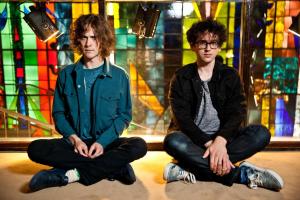
The headline act this year MGMT, a psychedelic pop band known to most for their singles, “Electric Feel” and “Time to Pretend.”

Other national acts scheduled to perform at this year’s Middle Waves include Thao & The Get Down Stay Down, Super Duper Kyle, Shannon & The Clams, The Lemon Twigs, Flint Eastwood and Selector Dub Narcotic.

Kelley said the festival has tried to provide more party- and dance-oriented hip-hop this year in answer to customer complaints.

One of the goals of the festival’s organizers this year was to “tighten” everything: simplify processes, streamline the flow, etc.

A major challenge last year had to do with local excise laws that prohibited alcohol purchased on one side of the street from being carried to the other side of the street.

That prohibition is still in effect, Kelley said, but there is a loophole.

“One thing they are allowing us to do this year is that you can go underneath the street at the MLK Bridge,” he said.

The enthusiastic and effusive response to Middle Waves last year was unexpected and heartening, Kelley said.

“One of the biggest surprises for us was the passion with which the community claimed it as its own,” he said.

Kelley said heavy rains made setting up the Flaming Lips show last year difficult, but patrons were up for any and all challenges.

“It was a soupy mess,” he said, “We had all this hay coming in and patrons joined us on the back of these pickup trucks and helped us spread hay.”

“I thought, ‘They paid to be here and they’re getting muddy,’” Kelley said. “That was just huge for us. People were helping carry amps. The positivity we felt during and after the event – it was more than we’d hoped for.”