Dweezil Zappa: Son of Invention

Standard

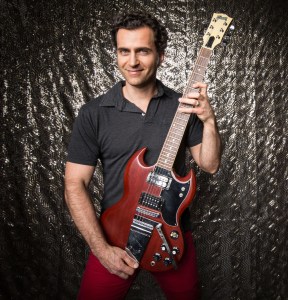
It is not uncommon for famous musicians to try to dissuade their kids from getting into the family business.

Frank Zappa went in the other direction, according to his son, Dweezil.

“He put ‘musician’ on my birth certificate where it said ‘religion,’” Dweezil Zappa recalled in a phone interview. “He already had some indication that I was going to take that path.”

On June 23 and 24, Dweezil will have taken a path to GearFest.

Even if you hadn’t seen the term GearFest before encountering it here, you were probably able to discern that it refers to a celebration of gear.

“But what kind of gear?” you may be thinking. If your guess is “fishing equipment” and your nickname isn’t “the fishin’ musician,” Sweetwater Sound’s GearFest may not be for you.

Gear in this instance means the tools for crafting and polishing music – the very tools that Sweetwater Sound sells around the world.

GearFest attracts between 10,000 and 15,000 attendees to Sweetwater Sound’s sprawling complex on U.S. 30 every year. They come to take in and partake of gear-centric exhibits, seminars, clinics, workshops, panels and performances.

It is free and open to the public.

Dweezil will be conducting a workshop sponsored by D’Addario guitar strings. Other celebs on site will include guitarist Eric Johnson, drummer Terry Bozzio, guitarist Andy Timmons, record producer Fab Dupont, drummer Omar Hakim, keyboardist Larry Dunn and drummer Mike Mangini.

For more than a decade now, Dweezil has been touring with a show called (for most of that span) “Zappa Plays Zappa.”

It is a showcase of Frank Zappa’s music, commandeered and performed by someone who knows as much about it as anybody and likely cares more.

Dweezil launched Zappa Plays Zappa partly because the people who were playing his dad’s music at the time were playing it wrong.

Frank was notoriously persnickety and imperious about his compositions, and he had a spiel for members of his band who had started to showboat.

“At a certain point, somebody would think they needed some star time,” Dweezil said. “They would try to start changing parts to draw attention to themselves. And that would be the point at which my father would say to them, ‘Window or aisle? How would you like to return home?’”

Dweezil needed two years of guitar retraining before he felt he could do justice in concert to his dad’s excellence on that instrument.

Another motivation for the creation of Zappa Plays Zappa was concern about his father’s legacy. Dweezil felt that young people really didn’t know much about his father beyond a couple of novelty tunes and his distinctive face.

These days, Frank Zappa’s legacy is under attack from an unexpected quarter: sibling rivalry.

After Dweezil’s mother died in 2015, his brother and sister, Ahmet and Diva, began to take legal steps to limit what Dweezil could do with Frank’s music.

Dweezil said he was was told that he couldn’t use the title “Zappa Plays Zappa” anymore and his suggested substitute, “Dweezil Zappa Plays the Music of Frank Zappa,” was rejected.

So he changed the name of the show to “Dweezil Zappa Plays Whatever Plays the (Expletive) He Wants — the Cease-and-Desist Tour.”

Dweezil said Ahmet and Diva have filed for a federal trademark to gain exclusive use of “Zappa.” If approved, it could block Dweezil from using his own last name professionally.

“We are still in the discovery phase of all that,” he said. “Lawyers back and forth. Meanwhile, they could easily stop any of that by saying, ‘If we get this trademark, we will not block you.’ They refuse to sign any document saying that.”

“At the same time,” he said, “they are telling the public, ‘We would never block him!”

Ahmet has told the press that he is willing to let Dweezil use “Zappa Plays Zappa” for a nominal fee of $1 a year, but what he doesn’t say (according to Dweezil) if that he wants 100 percent of profits from the sale of merchandise.

“Nobody would ever take that deal,” Dweezil said. “They don’t pay any of the costs related to the tour: the salaries, the travel.”

Dweezil claims Ahmet and Diva, who share a controlling interest in the Zappa Family Trust, plan to use Frank’s name and image to sell products he never would have endorsed when alive: yoga pants, for example.

“They have already put out the yoga pants with Frank’s name on them,” he said. “Why is it that Diva Zappa can make yoga pants with Frank’s name and image on them and I can’t say that I am playing Frank’s music?”

The irony here, in Dweezil’s estimation, is that he is the only one involved in this imbroglio who actually has a proven record of trying to preserve and extend his dad’s creative legacy.

Dweezil believes the law is on his side in a number of respects.

Some of the fallout from all of this is fan confusion, Dweezil said.

“It rubs (fans) the wrong way,” he said. “And then it also creates a certain element of people deciding to choose sides. Rather than unifying the family and saying, ‘Let’s make this the best possible version of the family legacy,’ they are creating this divide for no reason.”

Whatever that outcome of this, it seems apparent that Dweezil becomes more like his father with each passing year: more ambitious, more experimental, more multidimensional.

In March, Dweezil released a track to help raise funds for legal fees called “Dinosaur.”

It was assembled using a method his father dubbed “xenochrony.” Xenochrony creates a coherent pastiche out of related and unrelated snippets.

“Dinosaur” combines solos from nine guitarists including Frank Zappa.

Dweezil has a larger xenochrony-related project that he has been working on for more than two decades called “The Hell Was I Thinking.”

It is a massive guitar instrumental that currently features the work of roughly 40 guitarists.

“One of the big goals with that one too is to mix it in surround sound because I see it as an audio movie,” Dweezil said, “and I’d like it make it a completely three-dimensional experience.”

Dweezil is also taking his first stab at composing classical music. The finished result is scheduled to be performed by a 100-piece Dutch orchestra at the end of the year.

“If you had told me 12 years ago that one day I’d be writing orchestral music to be performed, I would have said, ‘What are you talking about?’”

Even as he expands his creative horizons, Dweezil knows that there will never be another self-taught polymath like Frank Zappa.

“He had the idea that you could put anything with anything for any reason at all,” Dweezil said. “There weren’t any boundaries. He was fearless in that way. The key to it was that he was an auteur who could do everything required to bring an idea to fruition. He didn’t have to rely on other people to bring an idea to fruition. He just needed to hire people to play a role and execute the part.”


Junifest

Standard

Fort Wayne’s first Germanfest, which happened in 1981, was surely an attempt to educate people with no naturally occurring German heritage about German culture.

That was 36 years ago. Germanfest long ago outgrew its humble origins and Hoosiers long ago outgrew their humble ignorance of German culture.

The 2017 edition of the festival starts June 4.

German culture is now such an ingrained part of Indiana culture that most Hoosiers probably don’t even realize what’s German and what isn’t, according to Germanfest’s treasurer and marketing director Bob Anweiler.

The unpretentious entrée most closely associated with the state, the pork tenderloin, is merely the German schnitzel or Wienerschnitzel in Midwestern disguise, he said. And many roast pork recipes owe a debt to German Schweinebraten.

Most Hoosiers grill “brats” all summer without once acknowledging their German origin, Anweiler said. Bratwurst is just one of about 1500 different types of German sausage. And there are more than 40 bratwurst recipes unique to more than 40 German regions.

As if this all weren’t surprising enough to some people, none of those aforementioned German regions is named “Stadium,” despite what it says on your package of supermarket brats.

It might be that 2017 is the perfect year for some more education.

A good way to expand your brat palate (one of the most important of all the palates) is to attend Köstritzer Night at Club Soda on June 5.

The Köstritzer of the title refers to Köstritzer Schwarzbier, a black lager produced by the Köstritzer Brewery near our sister city, Gera.

The oldest American breweries brag about having been founded in the mid-19th century.

That’s impressive until you find out that the Köstritzer Brewery is one year away from turning 475.

Köstritzer Schwarzbier confuses folks who are used to (and are used to avoiding) Irish stout. Yes, it is dark, but its taste is relatively light and clean.

It is a beer that is well paired with the Thüringer Rostbratwurst. The oldest known written reference to the recipe for this sausage was made in 1404, 139 years before the founding of the Köstritzer Brewery.

In other words, this is no fly-by-night nosh.

Believe it or not, Anweiler had to be kind of sneaky about getting out of Germany with the recipe. A police captain was recruited for the mission.

The whole story would make a great spy novel: “The Bourne Rostbratwurst.”

Food and drink has always been and will always be a huge part of Germanfest, of course.

Hundreds of gallons of homemade German potato salad and sauerkraut will be served during the festival, according to Germanfest president Ken Scheibenberger.

Massive quantities of kraut balls, kuchen (cake), handcrafted brats and currywurst (sausage with curry ketchup) will be sold.

Hundreds of kegs of Köstritzer and Hofbräu Original (a blond lager) will be quaffed, Anweiler said.

Yuengling beer will make its debut at Germanfest this year as well, he said.

Because there are many components to the festival in addition to the Headwaters Park component, there is always some confusion.

While Germanfest events begin to happen around the city on June 4, the opening of the Headwaters Park festival “tent” doesn’t happen until June 7.

This is the way things have been done for decades. That hasn’t prevented people from showing up at Headwaters Park on any of the four days before the opening of the festival tent or on the Sunday after its closing, Anweiler said.

“The main festival tent downtown is Wednesday, Thursday, Friday and Saturday,” he said. “Sunday is kind of the recovery day when you go to church and ask for forgiveness.

“Invariably, on that second Sunday, we have people showing up as we’re cleaning up,” Anweiler said. “And invariably, on that first Sunday, we have people coming down.”

The events that happen outside Headwaters Park are always well attended but Anweiler would still like to see more people at those.

“Especially the club night events,” he said, referring to Köstritzer Night at Club Soda and Hofbräu Night at the Fort Wayne Sports Club.

Schedules and information about such events as a wiener dog race, a sausage-stuffing contest, a beer-based test of strength, a polka lesson, a grape stomp, a beer and wine tasting, a choral concert, a German dinner and a beauty-in-lederhosen pageant can be found at Germanfest.org.

There was a time when there were only three summer festivals of consequence in Fort Wayne: Germanfest, the Greek Festival (aka Greekfest) and the Three Rivers Festival.

Nowadays, major and soon-to-be-major events happen on both sides of Headwaters Park through the end of September.

But Germanfest is first and will likely always be first. It launches a season of summer fun in Fort Wayne.

“We just have this really good environment for people to come down,” Anweiler said. “We always hope we have nice weather. It’s probably the first nice weather that people are able to enjoy where they aren’t worrying about it getting cold out.

“It’s a great way to start the season off,” he said.


Forbert’s Tune

Standard

It takes a special sort of young man to move from Meridian, Mississippi to New York City with little to his name beyond the guitar and harmonica that he knows will knock ‘em dead.

But that’s the sort of young man Steve Forbert was in 1976.

“I was very driven,” he said in a phone interview, “and I had the self-confidence it took to try anything.”

The attitude of Forbert’s Mississippi family toward his ambitions might be described as nonresistant.

“I didn’t get a lot of discouragement,” he said. “Naturally, they would have wanted me to go to college. But I think they saw I was going to have to try this, come hell or high water.”

Forbert performs May 20 at the B-Side in One Lucky Guitar.

After moving to Manhattan, Forbert lived in a series of hole-in-the-wall apartments in dangerous neighborhoods and worked as a courier by day. At night, he busked and performed in clubs, including the late, lamented CBGB.

This was a period when punk was ascending in New York City and there was no better place to watch its rise than CBGB.

Because Forbert never played punk, contemporary writers tend to assume that he must have been bucking the trend back then.

In truth, all sorts of music was being played in all sorts of places in New York City in the late 1970s.

“Absolutely,” he said. “That’s why it was so much fun.”

Forbert’s first album, “Alive on Arrival,” was not a commercial success but it was an enormous critical one.

He said he had some pangs just before the record was released because it sounded like nothing on the radio at that time.

“It wasn’t a chart album, but it got me off to such a good start,” he said. “But I listened to what else was out there and I thought, ‘Wait a second. The record’s coming out in a month and we don’t have anything disco and we don’t have anything straight, English rock.’ I kind of thought it was entirely possible that it wouldn’t find any type of audience.”

Forbert was called “the new Dylan.” Of course, every serious songwriter was called “the new Dylan” in those days.

Critics stopped using “the new Dylan” when most young listeners stopped being able to identity the old Dylan.

Forbert’s second album, “Jackrabbit Slim,” yielded his only hit, “Romeo’s Tune.”

It reached No. 11 on the Billboard Hot 100 and ranked 60th overall at the end of 1980.

Forbert had no idea that “Jackrabbit Slim” would be his breakthrough release.

“I don’t think I have ever had a moment where I said, ‘This is it. This is going to work,’” Forbert said. “I still haven’t had such a moment.”

One of the things that considerably slowed down Forbert’s career in the 1980s was a long dispute with his record company, a dispute that he said he will address in depth in his forthcoming memoir, “Big City Cat.”

Whatever the reason, Forbert missed a window of opportunity (or a window of serendipity) that might have given him a career like Tom Petty’s.

Instead, he has cranked out consistently excellent (if commercially underwhelming) albums, he has toured incessantly and he has built up a passionate fan base.

He provides that fan base with rare tracks and recordings of live shows via his website.

Forbert said he still enjoys touring as much as he ever has.

“I am doing four dates in a row in the Midwest and if you look at the schedule, it’s as zigzaggy as it could possibly could be,” he said. “I am not sure why that happens. I really look forward to it. I look forward to getting out there in the great American heartland. I love it out there.”

Each show requires a rendition of “Romeo’s Tune,” of course, and Forbert admits that performing it has gotten a little ”automatic.”

“That’s just the way it goes,” he said. “I am sure that when Paul McCartney tears into “I Saw Her Standing There,’ the crowd loves it, but it’s a little automatic for him too.”

But “Romeo’s Tune” has aged well, Forbert said. The lyrics (“Oh, gods and years will rise and fall/There’s always something more/It’s lost in talk; I waste my time/It’s all been said before”) certainly don’t sound at all strange coming out of the mouth of the septuagenarian.

“I still relate to it,” he said. “I like it. I don’t know what ‘Year of the Cat’ means to Al Stewart. It’s a great record. I always love to hear it. But the girl and the patchouli? What does that mean to him now?”

Young musicians who are still working on their own songs about girls, patchouli and related topics sometimes approach Forbert after shows seeking advice.

“I never would discourage people much,” he said. “Because I feel like if you’ve got to do it, then you’ve got to do it. So it’s a moot point.

“And if you don’t really have to do it and you’re just putting on a kooky hat and pretending to be a banjo player,” Forbert said, “Then you’ll drop it in ten months and you’ll move on to the rest of your life.”

Asked what advice he’d give his younger self if he could go back in time, Forbert said the proposition presents him with a quandary.

“The thing is,” he said, “innocence and naiveté are wonderful things. You can’t have your cake and eat it too. I had to make some mistakes and all. But that’s where the songs came from and that’s been my life’s work: writing songs. If I knew then what I know now, I probably wouldn’t have written a song like ‘What Kinda Guy?’”

Alt-Synopses: “Alien: Covenant”

Standard

Legendary director Ridley Scott returns to the universe he created in “Alien” with “Alien: Covenant,” the second chapter in a prequel trilogy that he promises will bridge the gap to the first film, a gap nobody perceived until he pointed at it.

“Alien: Covenant” will act as a semi-sequel to “Prometheus,” a semi-prequel to “Alien” and a semi-truck flattening your affection for this franchise.

In “Prometheus,” we learned that humans were created by a race of albino bodybuilders called the Engineers. At some point in the history of the universe, the Engineers apparently decided to kill all humans. The reason for this attempted genocide, according to allusions made by Scott in interviews, is that the Engineers were mad at humans for killing Jesus.

If true, this would be the worst plot twist since the ending of the “Planet of the Apes” remake, which featured a statue of Aperaham Lincoln.

Much of the plot of “Prometheus” concerned black goo devised by the Engineers for purposes that remained as murky throughout the film’s 124 minute running time as the goo itself.

The goo seemed as adept at creating underwhelming monsters as it was at generating arbitrary scenes.

At the end of “Prometheus,” Elizabeth Shaw and David the Android headed off to the planet of the Engineers, which they fully expected would be a technological, societal and environmental utopia.

In the new film, however, the Engineers’ planet is revealed to be the biggest disappointment since the Battlestar Galactica arrived at Earth in 1980 only to find it polluted by former “Brady Bunch” cast members and stock footage from the movie, “Earthquake.”

The “Covenant” of the title refers to a spaceship and surely is not meant to evoke the new covenant that Jesus established in the New Testament.

The Covenant is inhabited by six sets of couples, an arrangement designed to encourage colonization, pointless arguing, quick slaughter of the most annoying characters and aliens punishing people for having illicit intercourse.

The crew lands on the Engineers’ planet only to discover that is has largely become a barren, hellish wasteland, or – as it is referred to in the credits – Australia.

In “Alien: Covenant,” the black goo has become plant spores inside seedpods because why the hell not?

Alien DNA is scattered exactly the same way an innocent child scatters the seeds of an aged dandelion. In the new film, however, there are only aged dandelions of death.

Fox wisely abandoned the tag line: “Nature hasn’t been this evil since ‘The Happening.’”

In prior films, alien infants were known as chestbursters because of their method of egress from the human host. In “Alien: Covenant,” Scott will introduce backbursters, a nickname that should be self-explanatory.

Given the dwindling options, we are forced to consider the very real possibility that the next film will feature the debut of the assbursters.

“Alien: Covenant” opens tomorrow.

Viva La Revolution!

Standard

In 1981, bassist Andre Cymone left Prince’s band under contentious, ego-clashing circumstances.

Mark Brown said he knew of the subsequent vacancy, but he didn’t think he was in the running for the job or that he could put himself in the running.

“I didn’t think I would be considered,” he said in a phone interview. “He grew up with such a vast selection of awesome bass players in Minnesota. I was like, ‘Why would he pick me? I am the youngest of most of them. There’s no way.’”

Still, he kept seeing Prince in the audience at his shows. But he chalked that up to other factors.

Then one day, the phone rang at 11 p.m. at the community center where Brown rehearsed.

It was a guy claiming to be Prince.

“I was like, ‘This ain’t Prince. Get out of here,’” Brown said. “He didn’t say much after that. He just said, ‘I want you to audition for my band. I want you to learn all three albums. (Drummer) Bobby Z will pick you up tomorrow.’

“I worked at a 7-Eleven store at that time,” Brown recalled. “(Prince) said, ‘I’ll have him pick you up at 7-Eleven.’ I was like, ‘How did you know I work at 7-Eleven?’”

The unsuspecting Brown, aka BrownMark, was on the verge of joining the Revolution, one of the few backing bands in music history that became almost as famous as its frontman.

Prince would never lead its like again.

In the wake of Prince’s death, the Revolution reformed to pay tribute to its fallen leader.

It is now on tour, providing closure for fans and opening a new chapter for itself, perhaps.

The Revolution will perform Saturday at the Majestic Theatre in Detroit.

Brown recalls being nervous during the drive over to Prince’s house for the audition. His jitters were not eased when Bobby Z looked over at him and said, “Are you sure you want to do this?”

“I was like, ‘What is that? What kind of question is that?’” he said.

Brown was confident in his bass-playing abilities. He just wasn’t sure how he and Prince would get along.

“What was nerve-wracking was not knowing him,” he said. “I had heard all sorts of rumors about him. This was my first time meeting him, face to face. So my fears were more of, ‘How is he going to respond to me? How am I going to respond to him? Is he straight? Is he gay?’ I knew nothing.”

Apparently, Prince answered his own door in those days and Brown was not prepared for the sight of the man.

“Prince was literally about 5 foot 2,” he said. “I’m six feet and I am looking down on this guy. He had on leg warmers with shorts. His hair was coming all down and he had big earrings on. I just remember, I was like, ‘Holy crap.’”

Prince’s androgyny was a pretty radical concept in those days.

“Prince spewed sexuality,” Brown said. “When I saw him, I had never seen anything like that before.”

After the audition, Prince gave Bobby Z the night off, saying he would drive Brown home himself.

Brown wasn’t sure what to make of that either.

“I was like, ‘Oh, crap,’” he said. “I was thinking to myself, ‘It’s just me and this guy.’ I was like, ‘Wow, this is weird.’”

Whatever was happening in Brown’s overworked imagination, Prince merely used the drive to offer him the job.

“I was so happy, I almost (peed) my pants,” he said. “But I tried to keep my cool.”

Prince had a reputation as a tough bandleader and that toughness was on display from the first rehearsal, during which Prince repeatedly tugged Brown’s ear and kicked him in his hindquarters, saying, “Play the bass.”

Even when dispensing practical advice, Prince could be as enigmatic as a funky Confucius.

A funky Confucius wearing butt kicking boots.

But Brown said he eventually figured out that Prince wanted him to play more aggressively.

“That guy taught me so much about professionalism,” he said. “I owe him my entire career. If it wasn’t for him, I never would have been able to accomplish half of what I accomplished in my lifetime.”

Brown’s first concert, in front of a hostile Rolling Stones crowd, was as fiery as trials by fire get.

“I had only been in the group a month at that point,” he said. ‘Within the first few seconds of the opening number, a grapefruit landed on my bass keys. It knocked me clear out of tune. I sounded horrible.

“People were screaming,” Brown said. “Somebody got hit with a bag of chicken. Bottles we’re flying on stage. We were dodging stuff. Prince was so afraid of my reaction. He said, Mark, this isn’t the way it is. We were just trying this out.’”

Brown let Prince know that he wasn’t at all daunted.

Prince’s dream for the band that he would come to call the Revolution, Brown said, was something along the same lines as Fleetwood Mac: a band in which every member had something to contribute creatively.

The band sometimes jammed for ten hours at a stretch, he said.

“We were developing a sound,” Brown said. “That’s the work ethic he taught me. If you want to develop a unique sound, you play, play, play with each other. Don’t play songs. Just play. Release yourself. We developed this massive sound. He called it a freight train. That’s where the Revolution was born.”

The precision of the machine he’d built became evident during the writing of the song, “Purple Rain.”

“(Keyboardist Lisa Coleman) had some chords,” Brown said. “Prince had an idea. It slowly started to come together. I remember, I just sat there most of the day, listening to the changing, the progression. It was an all-day event. The song took on many different shapes and forms before we got it to where it was.”

“Purple Rain” – song, album and film – was the juggernaut that propelled Prince into the mainstream.

It was during this ascension that Brown began to fully appreciate the scope of Prince’s vision and the iron will that drove it.

“I call him a genius mastermind,” he said. “I believe in my heart, from ‘Dirty Mind’ forward, he knew what he wanted to do, where he wanted to go and how he was going to get there. He just had to figure out the pathway.”

It might be hard for some people today to appreciate the improbability of Prince’s massive success at that point in time, Brown said.

“For me, it was very explosive,” he said. “I was stunned. There had never been a band, a multiracial band, that had broken through some of the racial barriers of the time. I know about those racial barriers because I am a black man. And there were heavy racial barriers in the music business. Prince was determined to break through them, and he did. I was in awe.”

Prince’s decision in 1985 to add a half a dozen new members to the Revolution for the “Parade” tour doomed the band, Brown said.

“Two of the security guys were now at the front of the stage doing dance moves,” Brown said. “Everything started changing. I didn’t want to be a part of it. I was like, ‘Time for me to go.’”

He insists that the band never broke up, that no one was fired. Everybody just mutually decided to close that chapter.

Brown went on to found the group Mazarati. Prince gave Mazarati the song, “Kiss,” to record, and when he heard the band’s demo, he asked for it back.

Brown said he and Prince maintained contact over the years. Prince would call him out of the blue, using a silly pseudonym if Brown’s kids answered the phone.

“He used to call me 2, 3 o’ clock in the morning,” he said. “Sometimes he would call my house and my kids would run up to me and say, ‘Somebody named Alexander Nevermind is on the phone.’ I knew who that was.

“He always reached out to us,” Brown said. “He always stayed in touch with us. And that was endearing. I loved it. He truly was my brother.”

Brown said he heard of Prince’s passing by phone from a member of his security staff and cried for two days.

He was subsequently angry about the salaciousness of some of the media coverage.

“People immediately want to jump to a negative conclusion about a guy I knew,” he said. “They have no clue who he was internally. This guy was a very private man. And in that privacy, sometimes you make mistakes.”

Prince had been contending with excruciating chronic pain for many years, Brown said.

“I have female friends with hip issues,” he said. “Prince wore the high-heel boots. The difference between him and the women I know is that he didn’t just wear them. He danced in them.”

At the time of his death, Prince was planning to reform the Revolution and tour with the band, Brown said. He had secured promises from the former members that they would not perform as an entity without him.

The reunion happened. Just not on Prince’s terms, tragically.

Performing with the band mates he first met four decades ago is exactly like it was four decades ago, Brown said. Only better.

“We are the same,” he said. “Prince called us a freight train. That same energy is there and that’s what shocked me the most. He really put together a set of unique personalities. When we come together, that energy is so powerful that even we scratch our heads and say, ‘My word.’

“We’re even more seasoned now then we were then,” Brown said. “So it’s even more dynamic.”

There is a certain “New Orleans funeral” aspect to the shows – fans mourning by way of celebration.

Where it goes from here is up to them, Brown said.

“It’s going to be interesting to see how this involves and where we take it,” he said. “And a lot of that is going to depend on the fans, on what you guys want us to do. It’s going to be fan-driven.”

A version of this story can be found at Whatzup.com


The Gospel According to John

Standard

If you lived in a progressive town or city in the late ‘80s, the so-called New Folk Movement had a lot in common with the British Invasion.

The airwaves and stages were inundated with confident young acts that used folk music as a springboard into unexplored artistic realms.

The Paul McCartney of that movement in terms of talent and good looks was John Gorka.

He was a heartthrob to Reagan-era wearers of tie-dyed maxi skirts and patchouli oil.

With his baritone voice and woodsman’s beard, Gorka was folk music’s answer to Barry White.

Which is not to suggest that White required an answer from folk music.

That was 30 years and one digital revolution ago.

Gorka, well into his silver fox phase these days, never had much interest in his own sex appeal.

He is now, as ever, a compelling performer and earnest artist who is always trying to write a better song today than the one he wrote yesterday.

He will perform Friday at the Ark in Ann Arbor.

One of Gorka’s earliest mentors was the late Greenwich Village folk singer Jack Hardy, who taught Gorka a blue-collar approach to songwriting that turns out to be fairly unusual.

Most famous musicians will tell you that they eschew a songwriting regimen in favor of awaiting the muse.

But Hardy advocated a greater amount of self-discipline.

“It was the first time I had met someone who wrote songs on a schedule,” Gorka said in a phone interview. “He was finishing a song a week. That was his schedule for many, many years.

“I had never heard of that before,” he said. “I knew that novelists would sit down and try to write a page or a chapter a day. But I didn’t know songwriters could do that.”

Hardy’s view was that waiting around for inspiration to strike is a cop-out, Gorka said.

“He believed that if you work at it, you’ll get better, faster,” he said. “Even if you throw out three quarters of the songs you write, you will get better.”

Gorka said he started slow at a song a month. He worked up to two songs a month, and then he and his wife started having kids. The pace inevitably slackened.

Having a family meant that Gorka no longer had “large, unencumbered blocks of time.”

“They were great for musing and letting song ideas bubble up,” he said. “I used to be able to wake up slowly. That’s not an option anymore.”

In the midst of writing a song is still Gorka’s favorite place to be.

“Seeing where it’s going to go,” he said. “Even though you can work at it, the process is still a mysterious thing. The quality can vary. Sometimes a song takes a lot of work and sometimes it comes easy. Both of them can be equally good. And just because it comes easy, doesn’t mean it’s going to be any good.”

Gorka alters established songs in performance if he is dissatisfied with some aspect of them.

“I will change lines in a song that I don’t think were even right at the time or when they don’t seem to be right to sing anymore,” he said. “The world changes and the meaning of the song changes.”

Last year, Gorka was given an opportunity by his label, Red House Records, to release an unusual collection of personally primordial material.

“Before Beginning” features demo versions of songs that were eventually remade for Gorka’s debut album, “I Know.”

The demo versions were professionally recorded in Nashville with studio musicians, so the songs have more of a country flair than the versions that made it to vinyl and CD.

Gorka said the reel-to-reel tapes (which had been in the possession of the sessions’ original producer, Jim Rooney) had to be baked before they could be played.

Baking magnetic tape at a low temperature reverses deterioration, Gorka said.

“We didn’t use an oven,” he said. “We used a box with a hair dryer set on low.”

It had been at least 30 years since Gorka had last listened to the tapes.

The John Gorka of 30 years ago was a relentless performer who would go out on tour for long periods of time.

When Gorka and his wife started having kids, he curtailed this custom considerably.

“If you are away enough, people will learn to get along without you,” he said. “You want to stay indispensible.”

Gorka said he has a friend whose father was a frequently absent, long-haul truck driver.

“Until one day, he said to his mother, ‘Mom, that man is here again,’” Gorka recalled. “That was the end of his father’s long-haul trucking career.”

Changes in the music business have meant that musicians who used to depend on recordings to pay the bills now have to depend on touring.

Full-time folk musicians, on the other hand, have always had to do a lot of touring.

That doesn’t mean that artists like Gorka have been immune.

“In terms of the royalties that you get from streaming,” he said. “You get these ridiculous checks. I got one for one cent. I managed to save that one. It took 49 times that to send that check to me.”

A musician can laugh at a check like that or be discouraged by it, Gorka said, and he or she should always try to choose the former.

Gorka has no grandiose goals for his career at this point.

“I want to try to get the kids through college without enormous debt,” he said. “And to stay healthy and do it as long as I can do it. People have been coming out and that’s been really encouraging. I’ve been pretty lucky.

“I always think it could end tomorrow,” Gorka said. “So I’m grateful when people show up.”

(A version of this story can be found at Whatzup.com) 


A Loaf of Bread, A Jug of Wine, and Thou

Standard

Nichole Thomas, Cristal Reader, Lisa Beber are three wine-loving friends who are willing to travel to indulge their passion for the fermented grape.

Every summer, they attend the Vintage Indiana Wine & Food Festival in Indianapolis where they can taste hundreds of wines made by Indiana vintners.

They have long wondered why Fort Wayne doesn’t host a similarly expansive showcase of high-quality Hoosier plonk.

“Usually when we say that, we’re about a bottle of wine in,” Thomas said.

Fort Wayne offers many wine-centered events, of course, but nothing on the scale of Vintage Indiana. Craft beer is the libation that has garnered much of the attention of Northwest Indiana tipplers in recent years.

“Most (local wine-centered events) are beer and wine festivals and they have a limited number of wineries involved: maybe six to eight,” Thomas said. “If you’re not a beer drinker, then half of the ticket is kind of lost on you.”

So these friends decided to stop wondering and create their own event.

It’s called the Michiana Wine Festival and it happens April 29 in Headwaters Park East.

The festival quickly outgrew their initial conception of it, Thomas said.

“We kind of got into the thinking of, ‘Oh, we’ll have ten wineries. That would be great. Ten wineries from across the state,’” she said. “We’re up the sixteen now. That’s the most wineries that anybody in Fort Wayne has had in one place.”

Area faves like TWO-EE’s Winery, Country Heritage and Byler Lane will be in attendance, of course, but so will Buck Creek, Cedar Creek, Easley Winery, Fruitshinewine, Hartland Winery, Heagy Vineyards, Hedgegrove Meadery and Winery, Tippy Creek, Carousel, Rettig Hill Winery, Winzerwald Winery, Running Vines Winery and Satek.

Thomas said that they marketed the festival to prospective wineries as a “mini Vintage,” meaning a smaller scale version of the Vintage Indiana Wine & Food Festival.

In addition to the sixteen wineries, there will be nine food trucks on site, live local music and a spring craft market.

Cost is $30 per person in advance.

“I feel like $30 is a great ticket price,” Thomas said. “A lot of wine events are two and three hours long. This is six full hours. You get a glass when you walk in the door if you’re among the first 4000. After that, you’ll get a plastic cup. You basically can take that around and choose from among 100 wine samples.”

It is easy to make a person think they hate wine by serving them the wrong one at a dinner or reception, Thomas said. That’s why a festival like this is so essential, she said.

“I didn’t like wine at all before my girlfriends and I went on a wine trip,” she said. “I didn’t know ‘wine tasting’ existed before eight years ago, that you could go to winery and sample and find the wine that you like. Palates are so different that it’s hard to choose a wine to serve at an event. With a festival like this, people can come out and find the wines that they do like.

“Maybe they’ll come away from this and decide that they still hate all wines,” Thomas said, laughing. “And that’s important information to have.”

Thomas said admission to this inaugural edition of the festival is, by necessity, 21 and older. They may try to incorporate a family element in the future.

The night before the festival, there will be a 5K run (culminating in glasses of wine for participants). The night of the festival, there will be a concert in the pavilion featuring Knit Cap Vigilantes and the Fort Wayne Funk Orchestra.

Pre-purchased cost for the latter is an additional $15 for people who attended the festival and $20 total for people who did not.

Tickets for the festival and separate concert are available at area Kroger stores, participating wineries and at Rudy’s Shop downtown.

They hope to be able to use both sides of the park in the future, Thomas said.

“The sky is the limit,” she said. “We’ve have really good relations with the people who run Vintage Indiana. Originally, we thought, ‘Oh, my gosh. We’re only six weeks ahead of them. They’re going to think we’re competition.’ But they didn’t see it that way at all. They see this as a collaboration. We’re all on the same team, trying to get more people to drink Indiana wine.”

Deadpanning For Gold

Standard

Five years before he attempted his first stand-up gig, a teenaged Todd Barry performed comedy on “Late Night with David Letterman.”

Letterman may not have been aware that Barry was performing comedy. But that’s OK. Letterman didn’t have to know everything.

Barry was part of a Viewer Mail segment in which he claimed that he could do a great impersonation of the show’s bandleader, Paul Shaffer.

Barry can’t do a great impersonation of Shaffer, or even a tolerable one, but he never really thought he could.

He was lying for comic effect.

Letterman was fooled by this Barry’s ruse. Or maybe he was just pretending to be fooled for comic effect.

In an email interview, Barry said that he had not yet made the connection between comedy and vocation at that point.

“I always had an interest in making people laugh, but no specific direction regarding how I would do that or if I even wanted to do it,” he said. “I never considered doing standup until after college.”

Many years later, Barry made his legitimate debut on a Letterman-hosted program and somehow failed to mention the Viewer Mail segment.

“I tried to bring it up during a commercial break, but he was distracted,” he said. “I regret that I didn’t mention it to the producers.”

Deciding not to mention this to Letterman seems a very Todd Barry thing to have done.

Like many a stand-up comic, Barry is essentially a shy guy. His stage persona – dry with a touch of knowing smarm and plenty of space for letting jokes smolder – is not a calculated creation.

“I’ve never consciously worked on my persona,” he said. “It’s just what evolved, for better or worse.”

Barry performs Thursday at the Tiger Room inside Calhoun Street Soups, Salads and Spirits.

Thousands of performances ago, he took the stage for the first time at a Coconuts Comedy Club in South Florida. He did bits about McDonalds and circumcision, among other topics.

In the early days, he would record routines and listen to the audiocassettes in his car after the shows.

More than three decades have passed, but Barry said he still gets stage fright from time to time.

“I do still get nervous,” he said. “Sometimes that’s situational, like if it’s in an especially large venue…or a bad one.”

Barry’s deadpan demeanor onstage seems like it would be good for hiding vague unease and/or full-blown panic.

“Yes, sometimes pretending like you don’t give a (expletive) is helpful,” he said.

Some comics, like Stephen Wright, Jerry Seinfeld and the late Mitch Hedberg, are/were fond of working through drafts of potential jokes in notebooks.

But Barry said he can admire, but not emulate, that practice.

“I want to have that method, but I basically think of an idea and start working it out on stage,” he said. “I will occasionally sit down in a coffee shop and try to brainstorm, but I lose patience rather quickly.”

Barry did, however, muster enough patience to write a book.

“Thank You for Coming to Hattiesburg: One Comedian’s Tour of Not-Quite-the-Biggest Cities in the World” debuted in March to laudatory reviews.

The book is a celebration (with snark) of the so-called “secondary markets” where Barry performs. Perhaps Fort Wayne will make a future edition.

The hardest part of writing a book versus trying out stand-up material, Barry said, is the lack of a sounding board in the first endeavor.

“In standup, you know immediately if something works,” he said. “When I wrote the book, I had to guess whether people will like it and sometimes I wasn’t sure. But it’s getting decent reviews, so that’s relieving!”

Barry has described himself as a foodie in at least one prior interview (although it is predictably difficult in that context to tell when Barry he is joking and when he is being earnest).

Touring and foodolatry would seem to go hand in hand (or fork in mouth).

In truth, however, Barry’s chief criterion for choosing eateries is proximity.

“I often go on Yelp and search for coffee and restaurants that are near the hotel I’m staying at,” he said. “It’s nice to have something within walking distance, but I will get a taxi if I’m really feeling isolated.”

Loitering in nearby coffee shops for hours while writing nothing in notebooks is one of Barry’s favorite pastimes.

Like most prominent stand-ups, Barry has done guest shots on many TV series. He also played a major role in Darren Aronofsky’s “The Wrestler.”

A few years back, Barry toured with no prepared material and more such experiments may be in the offing.

“I’d like to do a bigger role in a movie, or be on a great TV show,” he said. “I’m also interested in doing some sort of live show that isn’t standup. But I haven’t figured that out yet!”


Alt-Synopses: “Fate of the Furious”

Standard

The last installment of this automotive mayhem franchise, Furious 7, left many questions that future sequels are obligated to answer:

  1. Can the series continue after the death of actor Paul Walker?
  1. Can the series continue to pretend that it never made reference to Tokyo drifting?
  1. Will the franchise be hampered by a recent Universal Pictures edict in which the characters are hereafter limited to driving one vehicle made by the series’ new sponsor: the Mitsubishi Mirage?

Fate of the Furious, which opens today, may provide some answers.

After Walker died, some pundits wondered whether Universal should just stop making films in the franchise.

But Universal executives said Walker would have wanted the series to continue, given that Walker had been very sentimental about Universal’s money.

The title of the new film features a veiled reference to the sequel’s chronological place in the series (essentially, “F8 of the Furious”).

Future titles now being considered by Universal include: The Fast and the Asi9 and Dis10ded and Furious.

The series has a checkered history. It almost didn’t bounce back from the universally panned third installment, The Fast and the Furry-ous, which was set in the world of animal costume fetishism.

Luckily, Universal quickly figured out what viewers really wanted and it has been giving it to them ever since: More automotive phallic metaphors than you can shake a phallus at.

Universal has every reason to be optimistic about the prospects of Fate of the Furious, but there are signs of trouble.

This is the second consecutive installment without the word “fast” in the title, which would seem to suggest that some sort of deceleration is happening.

Universal might want to have that checked out.

In Fate of the Furious, Dominic Toretto (Vin Diesel) appears to have turned evil and is battling his former crime-fighting cohorts.

Has Dom really become a criminal or will viewers find out, in a plot twist so shocking that only everybody would have been able to predict it, that he’s being blackmailed?

It’s probably that first one.

New cast members include Charlize Theron as a super-villain named Cypher. While it is easy to fault Cypher for her aloofness and insensitivity, she explains in the film that there really aren’t a whole lot of options in life for a girl whose parents named her Cypher.

Cypher has always secretly wished that her parents had gone with their first choice: Twinkles.

Cypher seems remarkably evil in the trailers, but how will she measure up to other memorable villains in the series: Tabula Rasa, Goose Egg and Diddly Squat?

Also joining the series is British acting legend Helen Mirren.

Fans almost blew a gasket trying to figure out what part she’d be playing in Fate of the Furious.

Luckily, Mirren eventually revealed via Twitter than she’d be reprising one of her signature roles: Queen Elizabeth.

The new film generated some controversy recently when Dwayne “The Rock” Johnson called some unnamed fellow cast members, “candy asses.”

We must consider the possibility that Johnson intended this as a compliment, given that an ass made out of actual candy would be quite advantageous in certain situations.

At one point in a trailer, we see Johnson drive a car with one hand while steering a torpedo with another.

If anyone can make us believe such a preposterous scene, it’s either Johnson or a man whose ass is made out of actual candy.

Fate of the Furious will compete with Disney/Pixar’s Cars 3 for the affection of automobile aficionados this summer.

It remains to be seen which film will win the coveted title, “Most CGI.”


The Importance of Being Andy

Standard

For two decades and counting, Andy Kindler has regularly done one of the scariest and gutsiest things a comedian can do: He delivers an annual State of the Industry Address at the Montreal Just for Laughs Festival.

This is an opportunity for Kindler “to comfort the afflicted and afflict the comfortable,” as the old newspaper adage goes.

In other words, he skewers and lambasts the most powerful people in his own industry.

Jay Leno, Ricky Gervais and Adam Sandler are frequent targets.

Kindler performs April 7 at the Tiger Room in Fort Wayne.

Last year, Kindler went after Louis C.K. at a time when Louis C.K. was popular with pretty much everybody.

Louis C.K. didn’t respond to Kindler’s remarks but fans of the former sure did.

“With the Louis C.K. thing, I did get blowback,” he said, in a phone interview. “I got blowback even from people I know. I won’t say who it is because I have enough trouble. Also, I worked it out. I’ve had arguments with friends of mine.”

Kindler’s beef with Louis C.K. (such as it is) is that Louis C.K. has cultivated an “aw shucks” persona that belies an ego and an ambition that are as large as anyone’s.

People often accuse Kindler of sour grapes but what really bothers Kindler is when a talented person is motivated by success (or the quest for it) to behave in cheesy or insincere ways.

One of the things about Leno that always bugged Kindler was how he would come out at the beginning of The Tonight Show and bask in applause, sometimes for as much as a full minute.

“If part of your show has to be you on camera being congratulated by the crowd, that says a lot about you,” he said. “Leno did that and Jimmy (Fallon) does that. Everybody who performs is needy. Everybody who performs wants the crowd to like them. But this is such a naked grab at audience support; I think eventually people see through that.”

After the fuss over his Louis C.K. comments died down, Kindler said he had “something like a spiritual breakthrough.”

“I used to feel like, ‘Oh man, I have gotta justify why I am doing this,’” he said, referring to the State of the Industry Address, “And now I’m more like, ‘Well, that’s what the thing is – it’s kind of like a roast of the business.’”

Kindler is adept at sniffing out B.S.

Four years before Fallon was widely condemned for a fawning Donald Trump interview, Kindler tweeted this: “‘I heard you were responsible for like 30 million deaths. That’s crazy.’ Jimmy Fallon interviewing Stalin.”

As much mileage as Kindler gets out of deflating pomposity, what really seems to bother him are racism and sexism, as is evidenced by his factious Twitter activity.

He is appalled by President Trump, but he tries to work out his rage on Twitter rather than in clubs, because anger isn’t funny.

Trolls tend to accuse Kindler of envy, but it would be disingenuous to pretend that Kindler’s comic credentials aren’t sterling. His timing and facial expressions, which evoke those of Jack Benny, can pull late laughs out of jokes that seem to have fallen flat.

In his routines, he is as hard on himself as he is on anyone else. He once described himself thusly: “(Like) Chris Rock, without the charisma, confidence and material.”

Comedy hasn’t made Kindler as wealthy as it has some of his loftier targets, but he doesn’t sound bitter about it.

When you love something like he loves comedy, he said, there are a lot of pathways to success.

“It’s always a trap when you have a dream that has to be so specific,” he said. “There are so many different ways of doing stuff and not everybody is going to have their own sitcom. And if you had your own sitcom, maybe you wouldn’t like it.”

Kindler, 60, said that he genuinely enjoys touring more than he ever has.

“I could lie to you but why would I lie?” he said. “Maybe because Trump is president now. The truth is, I really do love standup comedy now more than I ever did. I don’t know why I think nobody’s going to think I am being honest.”

It may be that rock musicians make their best stuff when they’re young and angry, Kindler said, but there’s no reason a comic can’t just get better and better.

“I have never been happier than I am now,” he said. “I have never liked my act better than I do now. Of course, by saying all this, I am jinxing myself. It’s like I am looking for ways to poison my next tour.”

Getting older has been a blessing in many ways, Kindler said.

“I hate to talk about how old I am, but I can’t stop talking about it,” he said. “In general, the good part of aging is – the way I felt in my twenties is that I was so consumed with ambition. I was so hard on myself. I had to achieve. When you get older, you just don’t have that same ambition. It doesn’t have to drive me anymore.”