Halloween in Southwood Park

Standard

screen-shot-2016-10-31-at-12-03-13-pm

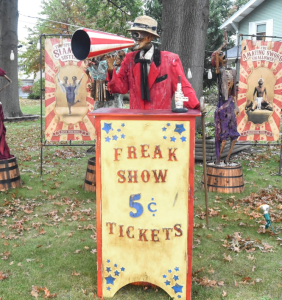
I remember my first Halloween in Southwood Park as if it were yesterday.

A little background: I came to Fort Wayne in 1998 from Massachusetts where I had lived in two college towns (although not simultaneously) for about 12 years.

College towns in western Massachusetts are not big on ostentatious holiday observances. A bystander or driver-by who likes to see Christmas lights on houses is hard-pressed to find examples of that holiday custom. I think I got five trick-or-treaters the entire time I lived there.

In the college towns of western Massachusetts, some people would rather be seen publically protesting a holiday (Columbus Day, especially) than be seen publicly embracing the trappings of one.

It wasn’t long after my arrival in Fort Wayne that I realized how different the Summit City is in this regard.

All holidays are loved unconditionally in Fort Wayne and each is celebrated to the hilt.

The first two neighborhoods I lived in here were Waynedale and Oakdale. Before I moved to Southwood Park in September of 2013, I thought I’d experienced the height of Hoosier Halloween hysteria.

But nothing could have prepared me for the way Halloween had achieved its quintessence in Southwood Park.

In Southwood Park, Halloween is like a block party that goes on for blocks and blocks.

It’s a blocks party.

Some homeowners transform their front yards into theme park-style attractions. Others haul out their grills and their coolers.

If you are a parent who looks hungry or thirsty or otherwise unfulfilled in life, you can expect to be offered a beer or a brat.

Diabolically decorated cars cruise around. Adults tend to be as extravagantly costumed as the kids.

There are moments you can look up and look around at seas of people in every direction.

It’s nuts in the best sense of the word.

It goes without saying that many of the families that participate in all this come from outside Southwood Park.

Some neighborhood residents are annoyed by that aspect of things. Some, like myself, adopt a “more-equals-merrier” mindset.

A Southwood Park Halloween isn’t for everybody. There are those of us who do not care to “look up and look around at seas of people in every direction.”

I get it and I respect it.

As for me, I didn’t really understand the adult appeal of Halloween until I moved here.

Halloween in Southwood Park is an annual opportunity for me to be comprehensively neighborly.

It’s like a town hall meeting – minus zoning squabbles, plus plastic fangs.

And it’s one of my favorite nights of the year.


Core Jester

Standard

rifftrax

People who have long dreamed about writing for Mystery Science Theatre 3000 and its offshoots might be too sensitive to learn that Rifftrax writer Conor Lastowka really didn’t know much about MST3K before he started working for Rifftrax.

“I was extremely casually acquainted with it,” he said in a phone interview.

How Lastowka came to work down the hall from former MST3K head writer and Rifftrax founder Mike Nelson is a story steeped in serendipity.

It all started when Lastowka invented a holiday.

Yes, he did and yes, it did.

Incidentally, Rifftrax’ latest live event, “Carnival of Souls,” happens Oct. 27 and can be viewed at the Regal Coldwater Crossing in Fort Wayne, among many other nationwide multiplexes.

While matriculating at the University of Virginia in the early 2000s, Lastowka and some of his buddies invented National High Five Day (which happens every third Thursday in April).

The gag went viral in a manner that most college pranksters can only dream of. And it has since evolved into a serious, charity-benefitting, annual event.

Eventually, Lastowka received an electronic mash note of sorts from the vice-president of Legend Films, a San Diego company that restores and colorizes black-and-white films.

“She emailed and said she saw it and liked it,” he said. “I saw her signature – that she was vice-president of Legend Films … And I wrote to her just like, ‘Hey, any chance that there’s a job there?’ not really knowing what they did.”

Lastowka had some video editing and social media experience so Legend hired him to fill gaps not otherwise filled at the company. And that was where and how he encountered Nelson.

Nelson was in the process of getting his pay-per-riff, movie-mocking venture, Rifftrax, off the ground with Legend’s help.

“Once Mike moved there and started what was going to be Rifftrax,” Lastowka said, “I did my best to weasel into that. It worked out where I would sort of be walking by his office and thinking of something funny to say.”

Keep in mind that Lastowka was not at this point an MST3K devotee.

“I finished high school in 1999,” he said. “We intermittently had cable. If it was still on in college, I’m sure I would have latched onto it. But I was a ‘Simpsons’ guy.”

Lastowka was eventually rewarded for stalking Nelson when the latter asked him to provide the voice of DisembAudio, a computer-generated, robotic toaster that was initially created to help Rifftrax patrons sync the audio with the video.

“I think I had a big enough job description that when he needed somebody to come in and do robot lines for RiffTrax, I had the most free time,” he said.

In due time, Lastowka was promoted to full-time writer and Rifftrax became emancipated from Legend.

conor_lastowka_2_ad_07-20-16_sn_7348-6

Lastowka said the MST3K vets with whom he works (Nelson, Kevin Murphy and Bill Corbett) were patient with him in the early going.

“It was my first writing job and it was my first comedy job,” he said. “And there were these guys who’d been on TV for a decade and had won awards. Mike was very gracious about the way they would do things and he would often explain if something didn’t work. My tendency was to be darker than they were because I was younger and I didn’t understand that it wasn’t always worth going for shock value.”

Rifftrax ultimately established a creative beachhead in Minneapolis, where MST3K had been launched in 1988.

These days, however, everyone associated with Rifftrax is scattered to the four winds.

Given the nature of the collaborative creative process in the digital age, people do not have to live in the same city, or even in the same state, to work together on projects.

So when Lastowka’s wife got a job in Vermont, he was able to move there without relinquishing his Rifftrax role.

The only office where the Rifftrax creative staff regularly convenes nowadays is an online one, he said.

“We have a copy of the movie that has a time code overlaid on it,” Lastowka said. “Sometimes we will refer to scripts if they are available and we need clarification, but most of the movies that we do do not have scripts available online. But for the most part, I have a video file open on one monitor and a script in a Google doc on another monitor and I look back and forth between the two.”

The idea that Lastowka gets to live in a picturesque New England town while contributing jokes to a savory national project would incite envy in even the most placid and satisfied writer.

“It’s delightful,” he said. “I can say that without reservation. I have a chance to travel a couple times a year to the live shows. When I get to taking it all for granted, which happens sometimes, all I have to do is get to the end of one of those live shows when we’re really all sort of look at each other and thinking, ‘That was really funny. It worked. The audience responded well. Tens of thousands of people saw this all around the country and it’s something that we built.’ So you do take a step back at those times.”

There’s a flipside to that jubilation, of course and it’s wearing tighty-whiteys.

“And sometimes I’m sitting around in my underwear trying to think of a joke,” Lastowka said. “ We did this awful movie where there were literally scenes of John Carradine and his assistant digging around in a lab for 10 minutes. They would sort of move around almost in silence. When you get to minute nine of that, you think, ‘This sucks. I hate this movie.’ So that balances out some of the other stuff. Still, it’s not like I’m digging ditches here.”


Perchance to Dream

Standard

hbe-pic

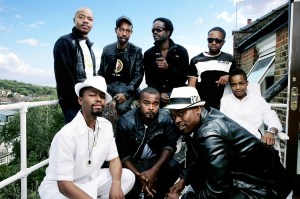
Before dawn every day, Chicago trumpeter Phil Cohran woke his numerous sons and made them practice their brass instruments.

Eight of those boys grew up and formed the highly acclaimed Hypnotic Jazz Ensemble, which will perform October 26 at the Embassy Theatre.

This is probably the sort of outcome that Cohran foresaw, but eldest brother Gabriel “Hudah” Hubert recalled in an email interview that the boys didn’t always share their dad’s vision.

“Waking up at any hour as a kid, besides the hour you naturally want to awaken, can definitely cause a child to be upset, bitter, resentful,” he said. “But our father is a military man, so he believes that early morning is the best time to get the best results. And with that mind state, look at us now.”

The music that the Hypnotic Jazz Ensemble makes is hard to describe. After he happened upon the troupe about eight years ago performing on a Manhattan sidewalk, New Yorker music critic Sasha Frere-Jones wrote this, “Certain genres sprang to mind—a New Orleans second-line band, say, or big-band jazz—but the music wasn’t jazz, exactly. The songs set small, compact melodies against a steady hip-hop beat, and everyone played simultaneously and continuously. The band had eliminated one of the dreary commonplaces of jazz, that class-recital rhythm of soloing—you go, I go, and so on, until the main melody returns.”

Later in the same profile, Frere-Jones added, “The music that Hypnotic plays might best be described as highly composed instrumental hip-hop. If it is jazz, it’s closer in spirit to jazz from a hundred years ago: accomplished and energetic music parceled out in short songs designed for dancing.”

Hubert said no label or salad of labels applies to what the Hypnotic Jazz Ensemble is doing.

“We think that journalists see what they’re inspired by,” he said. “So for us, we don’t fit in a box. So that leaves inspiration in hands of interpretation. Which gives us comfort. Music is universal, and an artist really sticks to that cold as we do.”

He said he understands why journalists might feel confused.

“What’s really funny is that hip hop and jazz coming from the same roots and environment,” Hubert said. “I think the best thing an artist does in creating is to conjure the purest form of that art.”

Hubert said the band ascribes to the Miles Davis quote: “There are only two kinds of music: Good and bad.”

“Critics wouldn’t get paid or make a living if they couldn’t divide and conquer,” he said. “ So we as the artist has to stand and create powerful offerings that shatter all doubt and ridicule.”

The Hypnotic Jazz Ensemble came perilously close to never existing. In 1996, brother Anthony Neal was murdered near the college he was attending at the time, the University of Illinois.

Hubert said the other brothers almost lost their way.

“When our brother was murdered, we were teetering on brink of diving deep into Chicago’s street life.” he said. “Where there is literally no return. But we had street guys in our circle who we grew up with and looked up to us. That convinced us to keep striving for greatness. They wanted to live through the potential of our success.”

The brothers saw a path out, Hubert said, and they realized that by following it, they could light the way for others.

“Where we come from, there isn’t much that’s tangible that inspires greatness,” Hubert said. “They realized as we did: There was a real opportunity for us to be beacons of light for the generations before us, with us, and behind us.”

Bands composed of family members are often uniquely contentious and the Hypnotic Jazz Ensemble is no exception, Hubert said.

“We absolutely butt heads on everything, and it’s frustrating to each one of us at different times,” he said. “But when there is a great idea on the table, it’s kind of hard not to go along with it.”

When strong families go into business together, the ratio of arguments to agreements is just naturally going to be about 70/30, Hubert said.

“It’s an interesting dynamic, but it works,” he said. “So that’s why, when people hear our music or see us perform, all the chaos has been filtered out.”

Success is an elusive beast in today’s music business if you measure it the old-fashioned way: Copies sold, Grammies accumulated, etc.

Hubert said the Hypnotic Jazz Ensemble has its own definition of success.

“In my opinion, success isn’t measured by where you want to be,” he said. “It’s measured by where you are. No one can see the future. You have no clue what’s in store you tomorrow, today, next year, or ten minutes from now. But we all know where we’ve come from, and also where are at present time. So to me, success is indicative of where I stand today.”

Satisfaction is being happy with what you have been able to accomplish up to the present moment, Hubert said.

“We want more, of course,” he said. “That depends of the strength of our tenacity and steadfastness, our dedication and our commitment to staying together throughout everything. But there is no doubt that we are a success story.”


Up To C2G I Send You

Standard

theband

In 2012, Fort Wayne-native and longtime Indianapolis-based musician Bill Mallers sat backstage with some band and stage mates after a show and contemplated the greatness of drummer and vocalist Levon Helm, who had recently died.

Someone suggested putting on a charity concert, with proceeds going to Helm’s financially troubled music studio, The Barn.

Mallers didn’t suspect it at the time, but the resulting tribute to Helm’s renowned roots rock group The Band would eventually grow into an annual, multi-state phenomenon, not to mention a part-time job for him.

“Such a Night,” Mallers’ live recreation of Martin Scorsese’s star-studded concert film, “The Last Waltz,” will be presented for the fourth time in Fort Wayne at C2G Music Hall on Saturday, Oct. 1.

“The Last Waltz,” widely considered to be one of the finest concert films of all time, chronicles what was then billed as The Band’s final show. It proved not to be the case.

In the latest Fort Wayne incarnation of the recreation, Kenny Taylor will appear as Eric Clapton, Dave Todoran will assay the role of Bob Dylan, Jack Hammer will channel Van Morrison, Chilly Addams will get at the essence of Neil Young, Marnee will embody Joni Mitchell, Bob Bailey will appear as Neil Diamond, Rick Barrand will play Paul Butterfield and DJ Doc West will intone as Lawrence Ferlinghetti.

Mallers’ Indianapolis-based group, The Haters, will back everyone up as The Band.

West, who has had notable interactions with many rock legends, said he had an interesting encounter with the post-film manifestation of The Band at the now-defunct Fort Wayne club, Piere’s.

West approached Rick Danko after the show to get an item signed and Danko replied, “OK. Let’s do it on the tour bus and bring your Heineken with you.”

“The Heineken was a fresh one,” West recalled, “and he goes, ‘Hey, do you mind if I finish your beer?’ And I go, ‘No! It would be an honor, Rick. Do it.’ He guzzled it down in two seconds. Bam, bam. He handed the bottle back to me and, as he handed it back to me, the door opened on the tour bus and it was Levon Helm.”

West later found out that Danko was on rehab at the time, so he was grateful that the timing of the bottle pass was such that neither he nor Danko got into trouble with Helm.

“Caught!” he said, laughing. “It was like we were teenagers.”

This isn’t the first time West has played poet and activist Ferlinghetti, who prefaced the historic concert with an eccentric version of the Lord’s Prayer called Loud Prayer.

West said the Fort Wayne editions of “Such a Night” have proved to be exciting.

“There’s a lot of spontaneity to it,” he said. “Because the local musicians rehearse along with the record or the CD.”

Mallers said the very first show was never intended to be anything but the last show, because no one wanted initially to be involved permanently or semi-permanently in a tribute act.

“But when this show was over, we all sort of looked at each other and said, ‘We’re in a tribute band now,’” he said. “‘We don’t want this feeling to end.’”

The organizers came up with the plan to present the show in a number of nearby cities annually, recruiting local musicians from each. The only constant would be The Haters.

“All of a sudden, it was like, ‘What a great idea!’” Mallers said. “We can go to different towns with the core band and enlist the cast from the town, and we’ll meet new musicians and we’ll have a blast and we’ll give some money to charity in every town we go to.’”

“Such a Night” now happens in Indianapolis, Bloomington, Louisville and Fort Wayne.

The charity in Fort Wayne that will benefit from this year’s show is the Community Harvest Food Bank.

The reason the concert seems to resonate with performers and audiences alike, Mallers said, is the variety. Portraying The Band means that the Haters (five permanent members plus three additional horns) get to act as house band throughout. It’s a role that comes naturally to them, he said.

Mallers and his seasoned musical cohorts have spent many years as sidemen and session musicians and have gotten quite good at melding with, and complementing, performers unfamiliar to them.

“When we’re backing up other people – in a way, I think the audience gets to see us do what we do best,” he said. “Whenever people get nervous and say, ‘Boy, this is a pretty big deal,’ I always tell them, ‘Don’t worry, because we’re just going to put you in a cradle and rock you back and forth like a baby.”

Longtime media personality Chilly Addams, who will perform Neil Young’s set during the show, said the movie helped him understand what life was really like for these rock pioneers.

He cited a Robbie Robertson quote from the film about how life on the road is a school where musicians either learn how to survive…or don’t.

“To know more and understand how it was like for those that were actually pioneering rock and roll; it’s an amazing thing to contemplate,” he said.

“I will always do everything I can to promote music to anyone and everyone, to keep it in schools and to give those who don’t have a lot of opportunities a chance to play.”

 

Calming Miranda: The Many Talents of Colleen Ballinger

Standard

mirandasings

In 2009, a YouTuber calling herself Miranda uploaded a video called “Free Voice Lesson.”

In it, a heavily-made up woman in a shabby-looking room stares earnestly into a camera and announces her intention to provide expert and pricey vocal instruction to whomever can be persuaded to pay based on a forthcoming “free voice lesson.”

For anyone with a modicum of human sympathy, the video is painful to watch. Miranda can’t sing but is utterly assured of her virtuosity.

“Free Voice Lesson” seems an unlikely launching pad for a comedic empire, but an empire answering to that description was launched.

Miranda, who goes by the full name Miranda Sings, will perform a show at the Embassy Theatre on Sept. 15.

“Free Voice Lesson” is an example of a genre of satirical YouTube video that aims to incite the haters with the plausibility of its utter incompetence.

Miranda Sings is the alter ego of Colleen Ballinger, who was a highly capable musical theater performer at Disneyland when she posted “Free Voice Lesson.”

She has said that she was motivated initially by a sturdy trend in the era of televised singing competitions: People who can’t sing pursuing singing stardom.

She told the Huffington Post in 2010 that she parodied people seeking fame on YouTube because she didn’t think anyone could get famous using YouTube.

“I was terrified when it went viral,” she said, “because I didn’t know what to do with it.”

In the beginning, Miranda Sings was a fairly realistic character. But Ballinger has since hyperbolized Miranda’s personality. These days, Miranda is no less preposterous than Martin Short’s Ed Grimley or Paul Reubens’ Pee Wee Herman.

Despite the character’s outlandishness, people still get confused, according to Miranda fan Haylee Ellison, a student at Carroll High School.

“A lot of people don’t know she’s a character,” Ellison said. “They think she’s an actual person who is just being rude.”

Ellison said Miranda is “a representation of people who think very highly of themselves and don’t care about other people.”

“She is the queen,” she said. “That’s what she calls herself and that’s what her fans call her. She’s very vain. But Colleen herself is super nice and amazing.”

Taylor Jaxtheimer, daughter of Three Rivers Festival chief Jack Hammer, said she appreciates Miranda’s anything-for-a-laugh ethos.

“She has no shame,” she said. “It’s worth it to watch because she is such a ham.”

Part of the character’s appeal, Jaxtheimer said, can be chalked up to a certain guilelessness. Miranda may say and do awful things at times, but her childlike nature robs viewers of the usual indignation.

“The whole thing is that she’s very innocent,” she said. “She doesn’t know when she’s making jokes. She makes a lot of innuendos and double entendres but her persona doesn’t know that they are funny or inappropriate.”

Ellison said she wasn’t sure Miranda wasn’t real until she stumbled upon the videos that Ballinger posts as herself under the PsychoSoprano tag.

“I was like, ‘Thank goodness that is not a real person,’” she said. “‘Because that would be so sad. I would feel so bad for them.’”

When people realize how different Miranda Sings and Colleen Ballinger are, Ellison said, it just makes Miranda funnier.

“After I realized she wasn’t real,” she said, “I spent the next month to two months basically going through and watching every single video she’d made.”

Rumor has it that Ballinger will make one or more appearances as herself during Miranda’s live show (one should expect a performance of her popular song about internet trolls, “Reading Mean Comments”).

And those who can’t make the live show will be able to sample Miranda’s wares in October when Netflix’ debuts a series based on the character called, “Haters Back Off.”

Ballinger told the MLive Media Group in 2012 that she feels immensely lucky for the turn her career has taken.

“I can travel the world and be a goofball and make people laugh,” she said. “It’s kind of ironic to be making a living doing what I was told (in college) not to do.”

She knows such fame can be ephemeral.

“I live every day like this could be the last one, like people could be over this tomorrow,” she said. “I don’t know when it’s going to end. I would totally understand and I’d move on to something else.”

Fort Forward: More Middle Waves

Standard

best-coast-3

(This is my second column on the Middle Waves music festival, published in the print version of Whatzup on Sept. 1)

Festivals are organized by committees, but not many festivals feel the need to engage the services of a vibes committee.

The Middle Waves Music Festival, happening September 16 and 17 at Headwaters Park East and West, has a vibes committee.

It is the vibes committee’s job, according to festival co-organizer Matt Kelley, to make sure the festival gives off the right vibes.

“You know, you have all the usual stuff: logistics and booking and marketing,” he said. “But it was like, ‘Who’s helping this thing have a personality that is distinctly ours?’ That’s what they’re charged with.”

It’s a fair bet that no Fort Wayne event has ever before radiated Middle Waves’ vibes. Middle Waves is a music festival the likes of which Fort Wayne has never seen nor heard.

It could put Fort Wayne “on the map” — a map drawn annually by people who are willing to drive to other states and other time zones for the opportunity to spend several days listening to a live mix tape and basking in vibes.

Middle Waves is what is known as a “destination music festival.” It’s what used to be known to Jack Webb’s counterculture adversaries on “Dragnet” as “a happening.”

People come for the music, of course, but the music is secondary to the ambience, the gist, the camaraderie, the élan.

The vibe.

“Many people in Fort Wayne travel distances large and small to attend destination music festivals,” Kelley said. “The thing you get to experience is the community you’re in. These festivals have a vibe unto themselves. Also…I don’t want to say they’re genre-less. They are curated. But the fact that you can see Kendrick Lamar followed by Radiohead followed by the Avett Brothers and nobody moves…that’s just something that we don’t really see at the festivals that exist right now in Fort Wayne.”

Kelley, who owns the design and marketing firm, One Lucky Guitar, said destination festivals like Middle Waves can’t be marketed like music festivals where a single genre is the theme.

“We have to market the experience,” he said. “And that you might hear Americana and then hip hop and then psychedelic rock and that’s OK. We’re excited about that fact that it will push Fort Wayne out of its comfort zone a little bit in a good way. We want to wake up the next day and say, ‘We did that and we’re cool enough for it.’”

Wondering if we are cool enough for things is a stigma Fort Wayne residents have suffered for decades. But the stigma may be on the wane.

Kelley said he was jogging with a friend of his this summer and his friend wondered aloud if he was cool enough for Middle Waves.

Kelley’s message to his friend and the entire city is: “Yes. You’re cool enough.”

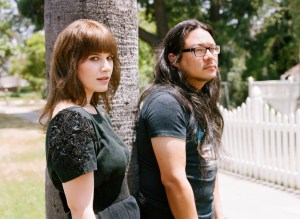
As of last weekend, the festival line-up had been fully announced and it features psychedelic garage rock (Jeff the Brotherhood), post-grunge (Bully), alternative hip-hop (Oddisee), electronic dance music (Tanlines), jazz rap (Sidewalk Chalk), jangle pop (Best Coast) and indie hip-hop (Doomtree).

Local acts will be mixed in throughout, Kelley said.

The news that the Flaming Lips would be headlining the festival generated more shock and astonishment on social media than a string of tornado warnings.

Fort Wayne has hosted popular bands and it has hosted cool bands, but it may never before have hosted a band this popular and cool.

All of this entertainment will occur throughout a Headwaters Park that has been transformed into its own small city: Middlewavesburgh.

And Kelley said he is already hearing from promoters who want to discuss Middle Waves 2017.

“They’re like, ‘What are you doing next year?’ he said. “They’re already planning that far out. They’re presenting options to us, ideas. It’s exciting to think that we’ll have even more options next year.”

Alt-Right Goes To The Movies!

Standard

lesliejones

Like a lot of people, I’d never heard the term “alt-right movement” until two weeks ago when Hillary Clinton mentioned it in a speech.

But after reading about it, I realized that I was well-acquainted with disciples of this movement, owing to my participation in movie-related forums and comments sections.

You aren’t going to find the front line of the alt-right movement at the polls. Instead, you will find it at the multiplex.

These are the guys who insist that they aren’t racist or sexist, really, but believe that armageddon is nigh whenever a traditionally white character is played by a black actor or a traditionally male character is played by female actor.

And when a black, female actor occupies space in a movie that these guys think should be reserved for a white, male actor…they get apoplectic.

They act like normal people do when their house is on fire but the fire truck hasn’t arrived yet. You could catch rabies from reading their comments on these matters.

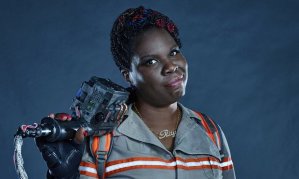
These are the sort of people who think Leslie Jones is more to blame for the fact that Bill Murray will never star in another “Ghostbusters” movie than Bill Murray is to blame for the fact that Bill Murray will never star in another “Ghostbusters” movie.

Blaming Leslie Jones for the lack of elderly, white and male comedians in the rebooted “Ghostbusters” franchise is like blaming Obama for the lack of penguins in Death Valley, it seems to me.

Which is not to suggest that Breibart wouldn’t accuse Obama of penguincide if it cared at all about perfunctory animal murder.

To reiterate: These people who think Leslie Jones exemplifies all that is wrong with the world and that male-driven action films exemplify everything that’s right insist they aren’t racist or sexist. Some of them see themselves as protectors of a definition of cinematic integrity that defies definition. Others see themselves as soldiers fighting shadowy culture defilers.

Among their many cherished conspiracy theories is that critical consensus is often achieved through bribery.

Whenever a movie about men with superpowers or supergadgets receives a preponderance of bad reviews or an action movie with too many women in it receives a preponderance of good reviews, these fellows laugh (bitterly) at the notion that these poolings of opinion could have happened serendipitously.

It is much easier for them to believe that the critics were paid off by some corporate entity or that all these critics got together beforehand and, in the interests of preserving snobbery or advancing so-called “pussification,” agreed to denigrate, en masse, unassailably great superhero cinema.

Given that most of the movie critics who once wielded real influence in Hollywood have either died or been demoted, I find it hard to believe that studios would spend a dime bribing the bloggers and recent J-school grads who do that job now.

I think it’s obvious to most clear-eyed and clear-headed people that superhero movies are the only guaranteed moneymakers in Hollywood at the moment. Hollywood would put a superhero in every movie if it could get away with it. Anthony Hopkins would be playing omnipotent, flying butlers if Hollywood had its way.

Despite such self-evident and inarguable truths, these guys truly do seem to believe that the superhero genre is imperiled, that it is on the verge of being banished utterly in the interest of feminizing men by indoctrinating them with high culture and strong female characters.

I wish I were kidding.

The aforementioned term “pussification” and its variants have been used against me. It refers, presumably, to the process by which a man is turned into a “pussy.”

“Mangina” is another one, as in male vagina.

Because I enjoyed the new “Ghostbusters” and because I don’t require my female action heroes to fight crime while dressed as lingerie models and dominatrices, I am repeatedly told that I must possess a mangina.

And I always reply, “Of course I have a mangina! I am proud of it. It is all manjazzled out. So bright is my manjazzling that it would blind your piggy, little eyes.”

Playground taunts like these are the exclusive purview of men whose sense of their own manhood is built on the shakiest of foundations. If you are employing such epithets and if they work on you, then you really do have something to worry about.

If you are the sort of man who entreats other men to “grow a pair” on social media several times a day, you should probably ask yourself why you have such an inordinate interest in other men’s pairs.

If all this sounds confusing to you, I know what you mean. Arguing logically with these guys is like trying to comb your hair with egg beaters.

But perhaps the preceding gobbledegook can serve as a preface of sorts to understanding why these guys hate Leslie Jones so vehemently and particularly.

Of all the things they find egregious about the “Ghostbusters” reboot, Jones is the most egregious.

And I’ll tell you why: She’s this blunt, unbridled, self-confident and successful black actress who makes no apologies, explicit or implied, for who she is.

Her existence triggers them. They need a safe space for their racism and sexism and she refuses to create one.

They think that they’re owed a world in which actresses are always the window dressing and never the window.

Even as they attack Jones with racist jibes that were old when Lincoln was president, they behave as if they are the injured parties.

Some of them may even believe it.

They’re gargantuan boys who failed to outgrow dumb ideas and were subsequently encouraged by slightly more clever man-children to turn those dumb ideas into a life philosophy.

They’ve been told by people like Milo Yiannopoulos that trolling, which is essentially blaming strangers for your comprehensive and interminable failures, can be a force for good in society.

It’s unmitigated horseshit.

As movements go, alt-right most closely resembles the bowel variety.

Long May It Run

Standard

cordd

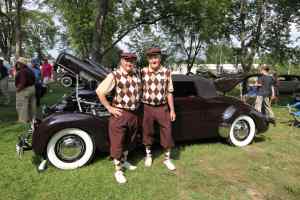
Sarah Payne grew up in Auburn, so the Auburn Cord Duesenberg Festival loomed large in her young life.

Four years ago, after a stint managing Riverfest at IPFW, Payne was put in charge of the ACD Fest as its executive director.

“It was kind of like a coming home,” she said.

The Auburn Cord Duesenberg Festival launched in 1956, which makes it thirteen years older than the biggest festival in Auburn’s municipal neighbor to the north, the Three Rivers Festival.

This year’s 60th Anniversary ACD Fest starts with a wine tasting on August 27 and concludes with a cocktail reception on September 4.

Managing events like these is tricky. You have to please the people for whom the festival is a beloved, venerable tradition and you have to make new fans as well.

“It definitely is a balancing act,” Payne said. “When I started with the festival a couple of years ago, we even ended up reevaluating our mission statement.”

Payne said the festival shifted its focus from pleasing current automotive enthusiasts to fostering future ones.

“We literally have strong festival supporters who pass away ever year,” she said. “So how do you get newer generations involved in something that is for many financially out of reach?”

One way is to add flashy new events like the Fast & Fabulous show, which debuted last year.

Any resemblance to real movie franchises, filming or wrapped, is purely delightful.

Fast & Fabulous features exotic and luxury cars that can’t be seen anywhere else.

“Last year, our goal was the have 25 cars come,” she said, “and we ended up with 50. It was awesome. It was just spectacular. They were just amazing cars. And partnering those with having these old cars downtown was just amazing. After the festival, I heard so many compliments. That night really was the first time in a long time that this younger crowd – teenagers, twentysomethings – were really interested in checking out the cars. I feel like we really hit the nail on the head with that event.”

Payne said she thinks they may see as many as 100 cars at the Fast & Fabulous event this year.

One of the goals with the festival going forward, she said, is to get a message out to people who are not necessarily obsessive about classic cars that the festival has a lot to offer them.

“Cars are the stars of the show, obviously,” Payne said. “But we want to make sure that people recognize that, even if you aren’t necessarily a car enthusiast, there’s a lot to do.

“I remember this old commercial for Indiana Beach: ‘There’s more than corn in Indiana,” she said. “Well we’re kind of branding ourselves as: ‘There’s more than cars in Auburn.’”

This year’s festival will feature auctions, a flea market, a parade, a swap meet, a wine tasting, a gala ball, a pancake breakfast, a formal dinner, a speakeasy, a pageant, numerous concerts and food trucks, an ice cream social and many other happenings.

The ACD Festival is one of those unique events that is composed of official and peripheral fun. The automotive enthusiasts who show up participate in official events and throw their own shindigs as well.

Payne said festival attendance is 100,000 and calls that a conservative estimate. She said as many as 700 or 800 vintage and collectible cars will be on display during the Friday Downtown Cruise-In on September 2.

Roughly 5000 cars will be featured at the festival in various contexts, she said.

Attendees and participants come from across the globe, Payne said.

When one considers that 100,000 people annually descend on a city with a permanent population of about 12,000, it does not seem as if there’d be much room for growth.

But Payne said she thinks there is space to expand a bit.

“We want to do it in such a way that we make sure we can accommodate,” she said. “We laugh: Our hotels in Auburn tend to fill up a year in advance. But what we’re finding is that there are hotels on the north side of Fort Wayne, Kendallville and Angola that can really benefit from the festival. So I don’t think we’re at capacity.”

Attendance can grow, she said, but what organizers are really hoping to do is to increase the festival’s demographic reach.

“I’m not an automotive enthusiast myself,” she said, “but I am an Auburn enthusiast. And so if I can instill what this festival means to our community in others here; hopefully, we have a fighting chance to get our kids and, hopefully, their kids to care and keep it alive.”


The Devil is in the Details

Standard

Charlie-Daniels-Net-Worth-2

Charlie Daniels first went on tour around 1971 and he may still be on the very same tour.

That’s hyperbole but the man has always worked hard.

He’ll turn 80 years old in October but he still takes a stage somewhere in the world about half the nights of a year.

In a phone interview, Daniels said his love of music is the reason for his force of will.

“I just love what I do and God has blessed me with the energy to do it,” he said. “If I didn’t enjoy it, it would aggravate me to death.”

Daniels performs at the Foellinger Theatre on September 1.

To people who can’t believe his stamina, Daniels jokes that he only works a couple of hours a day.

“When you only work a couple of hours a day,” he said, “you’d better make the most of them.”

Even though he was fitted with a pacemaker a few years back, Daniels said music still makes him leap out of bed in the morning.

Daniels came into national prominence in 1979 with the hit, “The Devil Went Down to Georgia,” surely one of the greatest story songs and one of the greatest crossover songs in the history of country music.

It was constructed one day during a jam session from phrases that had been rattling around in Daniels’ head: “Oh, hell’s broke loose in Georgia,” “Fire on the mountains” and “rosin up the bow,” among them.

They are all from a poem by Stephen Vincent Benet called “The Mountain Whippoorwill” about a fiddle contest without the diabolical implications of the resulting song.

He and his band have surely played it thousands of times, but Daniels said he never tires of revisiting it or any of his hits.

“The reason is that I always get a fresh chance to play better tonight than I did last night,” he said. “I haven’t done anything perfect yet.”

Daniels said he has never understood performers who seem resentful and combative during concerts.

“There’s really no downside to entertaining people,” he said. “If they like what you’re doing, you should like what you’re doing.”

Touring can be hard on the touring musician’s family, but Daniels said his wife and son have always accepted the trappings of his chosen profession.

“My family always understood what I am trying to do and were willing to go along with it,” he said. “As soon as my son started college, I outfitted a bus so my wife could be with me.

“We’ve been traveling together ever since,” Daniels said. “I’d quit if my wife were not with me. I’d hang it up. We have an adventure every day.”

It was about 50 years ago that Daniels drove a clunker to Nashville with a wife, baby and $20.

One of his first major gigs was playing electric bass for Bob Dylan on his controversial “Nashville Skyline” album.

Dylan subsequently hired him to play on “Self Portrait” and “New Morning” as well.

The music business has had its up and downs since then (mostly downs), but Daniels is fairly insulated from all that thanks to his loyal following.

Daniels releases new music (including a recent collection of acoustic Dylan covers) on his own label, “Blue Hat Records.”

“It’s a good situation,” he said. “I’ve been at this a long time and I didn’t want to be under some record company where I can’t operate the way I want to, where I can’t pick my own songs and musicians, where some A&R guy is trying to tell me what to sound like. I want to sound like me.”

Daniels said the Dylan album was inspired by some work his band did for the AMC show “Hell on Wheels.” They were restricted to playing period instruments – all pre-1900 – and the music they made sounded so good to them that they decided to come up with an excuse to keep playing it, or something very much like it. Thus, the Dylan album.

Daniels lives and records far enough away from Nashville to be estranged from the Nashville “scene.”

“We’re out in the country,” he said. “Our offices are out there. Everything is in the country. I love Nashville. But what goes on in Nashville has very little to do with what we do and the way we want to do it.”

Daniels said he doesn’t listen to enough contemporary country radio to weigh in with an opinion on it.

But he does observe that the system seems designed to discourage rather than encourage multitalented individuals like Zac Brown from forging ahead.

Daniels intends to keep forging ahead. The only thing that would convince him to retire would be physical limitations.

“I’d have to live to 150-years-old to get to all the ideas I have,” he said. “I am never short of ideas. I don’t ever want to do a bad show, however. I don’t move around as fast as I used to but music still loves me and I can move around pretty good for a senior citizen. But I have way too much respect for the music industry to stay after the fruit is past ripe. If I ever felt like I was not giving people their money’s worth, I’d stop.”


Fort Forward: Middle Waves

Standard

middlewaves

With all the redevelopment and refurbishment going on throughout downtown, it would be easy to underestimate the significance of Middle Waves.

Middle Waves, which will happen September 16 and 17 at Headwaters Park, is a music festival of a type that Fort Wayne has never before attempted.

Fort Wayne already has popular festivals devoted to specific genres like country and electronic music.

But Middle Waves aspires to be something grander, a music festival that will transcend genre and geography.

Middle Waves is the brainchild of a number of likeminded, local trailblazers: Matt Kelley at One Lucky Guitar, Alison Gerardot at Riverfront Fort Wayne, Sweetwater Sound’s Chuck Surack, Corey Rader at the Brass Rail, Dan Ross at Arts United and Alec Johnson with the City of Fort Wayne.

The template for Middle Waves is so-called “destination festivals” like Bonnaroo and Coachella, music festivals that many people feel compelled to attend every year (some of them traveling quite a distance) regardless of who is performing.

The idea for the festival, Gerardot said, grew out of an “intercommunity visit” that members of Greater Fort Wayne took to Des Moines, Iowa, two years ago.

“What those community leaders in Des Moines were saying at that point in time,” she said, “was ‘We were where you are now’ in terms of momentum. ‘Everybody can feel it. Everybody knows.’”

“‘But we have this one event in our community called the 80/35 Music Festival,’” Gerardot remembered them saying, “’that really turned the tide for everyone sort of working in unison to just continued to really push this community forward.’ They say that’s the event that happened in Des Moines where everybody woke up the next day and finally realized that they were cool.”

Kelley said it has always been an “underground dream” to start, or have someone start, a festival like this in Fort Wayne.

But once sponsors began boarding Middle Waves, the dream quickly became a reality.

Kelly said the name of the festival was meant to evoke Fort Wayne’s rivers (the focal point of so much new excitement), “waves of grain” (the focal point of so much pastoral nostalgia), and “making waves” (the focal point of so much idiomatic bravado).

From an operations perspective, Kelley said, Middle Waves is not-for-profit. All the aforementioned organizers are volunteers.

One of the lynchpins of the whole venture was fastened when festival headliner, the Flaming Lips, was signed.

Fort Wayne had never before lured a band of that stature and hipness to northeast Indiana and it gave the festival instant buzz and cachet, not only among local music fans, but among national talent bookers as well.

“Yeah, well, we’re excited about them,” Kelley said. “Because they are, in some ways, the quintessential festival band. You’ve seen them at Bonnaroo and Glastonbury. There’s an immediate legitimacy to a festival they are a part of.”

Other bands signed thus far include Best Coast, Doomtree and Jeff the Brotherhood. More bands will continue to be signed into September.

Kelley said they have 28 slots to fill on three stages over two days. He said another group of signed acts should be announced around the first week of August.

Fort Wayne has a reputation as a place where folks tend to buy tickets at the last minute, but Kelley wants to encourage people to buy early, because every dollar organizers get now can and will be spent on this year’s festival.

Kelly wants to stress that Middle Waves is not just for youngish people.

“We’ve kind of positioned this as, ‘We want young people to love living here,’” he said. “But they had age diversity (at the 80/35 Music festival) and it was really cool. You’d have hip-hop going with folks in their mid-50s bouncing up and down and it was like, ‘Boy! This is all the diversity we would hope to see.’”

“The diversity at that festival is something that we hope to transport to this festival,” Gerardot said. “It wasn’t just young people. It was all people. Lots of families. I was shocked. 60- and 70-year-olds just hanging out and listening to Nas.”