
Silver Tongued Devil

Standard

HOLLYWOOD, CA - FEBRUARY 14: (EXCLUSIVE COVERAGE) Gene Simmons of KISS performs at Mending Kids International's "Rock & Roll All-Stars" Fundraising Event on February 14, 2014 in Hollywood, California. (Photo by Michael Bezjian/WireImage)

Just as disco was putting guitar rock into a temporary sleeper hold, KISS was touring the country in a station wagon.

The foursome made the princely sum of $75 apiece per week, according to front man Gene Simmons.

They undoubtedly traveled sans makeup, but it’s fun to think of a kid glancing over on the highway in 1974 and seeing a woody wagon filled with glam rockers.

“We went to the heartland,” Simmons said in a phone interview, “because New York and LA were too busy doing the disco stuff. And we went to Fort Wayne and we went to Mankato and we went to Saint Joseph and we went to Paris, Texas. Places like that. That’s where they remember you.”

Four decades later, the band (minus two of its original members) has been returning this summer to some of the midsized and fun-sized cities that first embraced it.

KISS performs August 12 at Memorial Coliseum.

“The buildings (in these towns) might not be as tall as the ones in New York,” Simmons said. “But buildings don’t determine cool. People do. The people in small towns will tell you what they think and the rest be damned. They don’t care. If they like and love you, they like and love you. They don’t care if anybody else does.”

The erudite, outspoken and cocksure Simmons has gotten himself into various degrees of hot water over the years because of his tendency to tell you what he thinks and the rest be damned.

But it would be hard to criticize his work ethic. The band has earned some laurels on which it could conceivably rest. In 2015, Recording Industry Association of America (RIAA) announced that KISS had earned more gold record album citations (30) than any American band in the history of such certifications.

The awards wouldn’t mean anything, Simmons said, if the band decided to perform future shows as if the memory of a former greatness was all it was required to deliver to its current fans.

“At the end of the day, the only thing that’s important is what you do on stage, proven tonight,” he said. “Before we get up on stage, I know that show is going to be the most important concert we ever play. And we’re going to take it deadly seriously because that’s what we do.”

At the age of 66, Simmons still straps himself into 50 pounds of armor every night and climbs aboard 11-inch platform heels.

He recalled the opening show on this tour, which happened outdoors in Tucson.

“The temperature was 103,” he said. “Add to that the stage lights, which probably raise the level another 10 degrees. And when the fireballs kick in, maybe another 10 degrees. You’re talking about 120 degrees on stage with about 40 percent humidity factor.

“So all night we’re chugging water,” Simmons said. “We’re trying to catch our breath. We don’t use backing tracks. We don’t lip synch. We work for it. This is the hardest working band in show business. Pride is an important word.”

Simmons said people roll their eyes sometimes when he talks about the band’s high standards.

“They go, ‘Oh boy. He’s so full of himself,’” he said. “You’re damned right we are. We’re proud to get up there at every show and introduce ourselves with a pretty cocky statement: ‘You wanted the best. You got the best. The hottest band in the world.’”

KISS became one of the world’s hottest bands through an unlikely combination of makeup, cosplay, stage pageantry, savvy songwriting and pop mythologizing.

Each member of the band was a celebrity in his own right in the 1970s.

The various men who have replaced lead guitarist Ace “Spaceman” Frehley and drummer Peter “The Catman” Criss since the early 1980s aren’t nearly as vivid in most people’s minds as their progenitors.

But the core of the band remains the same: Simmons (aka the Demon) and Paul “The Starchild” Stanley. It’s a professional marriage that has not been without its strife, Simmons said.

“We never butt heads which is a strange combination of two different sides of your body,” he said. “We always disagree about everything. But I think it’s fair to say that we’re two different sides of the same coin. We share the same work ethic, the same commitment to the band, the same commitment to the fans. Show up on time. There’s no Axl Rose behavior here.”

Simmons, being Simmons, told a story of a confrontation he once had with Rose.

“I told him to his face: ‘You’re the luckiest son of a bitch who ever walked the face of the planet. Now, at least don’t insult your fans and show up on time.’ People who buy tickets are giving you a gift. Even God doesn’t do that.”

KISS came up at a time, Simmons said, when a rock band had to deliver on stage in every conceivable way and the band won’t abandon those values.

“We put on a show,” he said. “We’re apolitical. We don’t tell you what to do or what to think. What’s the secret of life? I have no idea. What we do is celebrate life. On our tombstones, it’s going to say ‘KISS Gave Bang for the Buck.’ If that’s our only legacy, it’s enough.”

Bands that wing it, mail it in or let personal shortcomings imperil their professional obligations are doing their fans a grave disservice, Simmons said.

“It’s easy to forget that you’re not the boss,” he said. “You just work here. The fans are the bosses. We owe them everything. Without them, I’d be asking the next person in line, ‘Would you like fries with that?’”


Frampton Shows Us the Way

Standard

peterframpton

In 1977, three pop stars vied for space on the covers of teen magazines like Tiger Beat and Teen Bag: Leif Garrett, Shawn Cassidy and Peter Frampton.

About the only thing Frampton had in common with those young men was his towheaded pulchritude.

While Garrett and Cassidy were native Californians with little discernable musical talent, Frampton was a well-established and well-respected British rocker who was enjoying the unforeseen fruits of a monster success: a double-disc live set called “Frampton Comes Alive!” which had just surpassed Carole King’s “Tapestry” to become the bestselling album of all time.

Frampton’s time in the limelight was brief. Some blame confusion over Frampton’s teen idol appeal. Some blame Frampton’s decision to star in a critically reviled, big-screen, jukebox musical based on the Beatles’ “Sgt. Pepper’s Lonely Hearts Club Band.”

Frampton, who performs July 31 at the Foellinger Theatre, blames the pressure he felt to come up with something half as newsworthy and noteworthy as “Frampton Comes Alive!”

“I guess I got very excited,” he said in a phone interview. “Everyone was riding the crest of a wave and it was a very exciting period. But it can have its downside too…You’re not only a successful album, you’re not only a number one album, you’re not only a platinum album many times over…Now, go follow that one up.

“And that’s where the pressure really came in,” Frampton said. “I don’t think I was, at that point, ready to go right back in and do the album that then became, ‘I’m In You.’ That should have been done about three or four years later. We should have just waited. Because, people say you’re only as good as your last record. ‘My last record was the biggest record of all time. I think I’ll wait a little bit.’”

Frampton acknowledges that his career didn’t progress precisely as he’d hoped but he has no major regrets.

“I’m still here talking to you,” he said. “‘Frampton Comes Alive’ is 40 years old this summer and I couldn’t be more proud of it. We’re still talking and I’m still playing around the world to wonderful audiences.

“That’s something I love to do, playing live,” Frampton said. “It’s something I am able to do as long as I want to and that is a very luxurious position to be in. I couldn’t be more grateful.”

Of course, being a celebrity musician and being a good musician are sometimes mutually exclusive concepts.

Frampton was a good musician before he got preposterously famous and he has improved considerably since fame faded.

His chops are well displayed on his latest album, “Acoustic Classics,” a collection of stripped-down hits and deep cuts.

The idea was to commemorate “Frampton Comes Alive!” in some fashion. But he said he could never do slavish remakes of any of his old material so he tried a different tack with this.

“I can’t go backwards,” he said. “I want to go onwards and upwards. What I decided to do was do it acoustically and do it as if you had come over for coffee and I said, ‘Hey, I’d like to try this new song out on you that I just wrote last night.’ And I get the guitar and I sit down at the kitchen table and I play it for you.”

Releasing an album in 2016 is a different proposition from releasing an album in 1976, Frampton said.

“A lot of people have said what I am about to say,” he said, “but you used to go out and tour to promote an album. Now we make an album to promote a tour. It’s completely reversed.”

The album that eventually outsold “Frampton Comes Alive!” in 1978 was another double disc set: the “Saturday Night Fever” soundtrack.

The double album has since gone the way of the rotary phone, the three-martini lunch and the human attention span.

“You don’t need to put out as much stuff at once,” Frampton said, “even though I did with this ‘Acoustic Classics’ because I felt that that there were songs I knew everyone would want to hear and also songs that maybe didn’t see as big a light of day.”

From an artist’s standpoint, the streaming music economic model is about as far from the double album economic model as canned tuna is from fresh lobster.

“I’ll just give you a figure,” he said. “An iTunes download was 99 cents; $1.29 for better quality… I know people who have had a hit record and it’s streamed hundreds and hundreds of thousands of times and their check is $31. You’d be better off being a vacuum salesman door-to-door than a musician.”

The streaming music booster club claims that streaming gives artists massive exposure that they can use to make money elsewhere and in other ways.

But that may not mean much to a serious musician who has never had much interest in using his music or celebrity to sell skin products or colognes.

Frampton has lived in Nashville for several years and he said many of his friends and friendly acquaintances there have scaled back their musical aspirations.

“I just know from the songwriters who have had to go back and get day jobs,” he said, “and engineers from studios – the same thing. And studios that have closed down. It’s quite amazing to think that if it goes on much longer…people are going to have to go into debt to make records and not get the money back. It’s a losing concern.”

2016 has felt like a particularly pivotal year in the music industry with the passing of such giants as Prince and David Bowie.

The lives and careers of Frampton and Bowie were intertwined since the two were teens.

Frampton and Bowie attended a technical high school located in the Bromley suburb of London where Frampton’s father was an art teacher. Frampton sat in on jam sessions with Bowie and his mates during which they performed the music of such American rockers as Buddy Holly and the Everly Brothers.

Bowie was still called David Jones at the time.

“David was already in a local band called The Konrads and I’d seen him play and he was already a mentor of mine right from the off: ‘I want to be like him,’” Frampton recalled. “So even though we were only three years apart, he was already someone I was looking up to. He was already singing like Elvis and playing sax as well.”

Bowie went on to open for Frampton’s band Humble Pie.

When Frampton’s career took a nosedive in the early 1980s, Bowie invited him to join his band. Frampton’s stint as Bowie’s guitarist reminded people of his virtuosity on that instrument.

“With the ‘Glass Spider’ tour, he could have chosen any guitar player he wanted and he chose me,” Frampton said. “We’d always wanted to play together on the same stage at the same time. It was a wonderful gift. He took me around the world and introduced me as the guitar player. It was incredible.”

Being known as a guitar player is all Frampton has ever really wanted.

“I just want to play something on the guitar today that I couldn’t play yesterday,” he said. “It’s just always been about the guitar for me. I’m so lucky that passion reinvents itself. That is something that I have always been so thankful for, that my first addiction is still with me and it’s roaring right now.”


Life’s Been Good to Him So Far

Standard

joewalsh

Most music aficionados who do not play an instrument know Joe Walsh by his nickname, “the clown prince of rock.”

They also know him for such funny, self-deprecating hits as “All Night Long” and “Life’s Been Good.”

What many of them probably do not know is that Walsh, performing at the Foellinger Theater on August 2, is widely acknowledged as one of the best guitar players in rock music.

Joey Ortega (aka Joey O), a northeast Indiana resident who is widely acknowledged as one of the best guitarists in the Midwest, has been well aware of this for a while.

He remembers watching a DVD of Eric Clapton’s 2004 Crossroads Guitar Festival, which featured performances by Robert Cray, Jimmie Vaughan, Jonny Lang, B.B. King, Buddy Guy, John Mayer, Steve Vai and Walsh, among many illustrious others.

“It had all of Clapton’s buddies in it,” Ortega said. “And Joe Walsh for me was the highlight and that’s saying a lot. When I watched that, my mouth was hanging open: ‘Holy (expletive)! Did Joe Walsh just steal the show? Was Joe Walsh the best guitarist there?’ He just killed it.”

The average person little suspects that Walsh enjoys such a distinction, Ortega said. But another guitar player will “be the first one tell you that [Walsh] is one of a small handful of guys who can really play,” he said.

Chilly Addams, a longtime local media personality and a bassist in the band Phil’s Family Lizard, said Walsh isn’t the sort of player who tries to dazzle you with how many notes he can pack into a solo.

“He’s not into making it so technically difficult and awesome that people go, ‘That was really technically difficult and awesome,’” he said. “It’s more like, ‘That was really fun! That sounded great, man!’”

“Not a lot guys express themselves at his level,” Ortega said. “Any kid in any little town can play fast, but at the end of the day, that means about as much as talking fast.”

Walsh came up at a time, Ortega said, when the better you could play, the cooler you were.

“If you couldn’t play, you were David Cassidy,” he said. “Nowadays, everybody wants to be David Cassidy.”

Venerable local DJ Doc West may not be a guitarist, but he has been a sagacious and passionate music devotee longer than Walsh has been a professional musician.

West recalled seeing Walsh perform with the Cleveland-based James Gang in 1969 at a now defunct Columbus venue called the World Theater.

Clapton’s band Cream was popular at the time and the James Gang had whittled itself down to a power trio in a similar vein.

“He was just phenomenal on guitar,” West said of Walsh. “I remember thinking that it was like Ohio had its own Cream.”

A year later, West saw the band open for The Who. That was the tour where Pete Townshend first developed his lifelong and oft-expressed love of Walsh’s playing.

“Pete Townshend said, ‘Hey, we love a band from your parts here called the James Gang,” West recalled. “Everyone went nuts. He said, ‘You know, they just released an album called Yer’ Album and we love it. So tonight, we want to be known as Yer’ Who.’”

Ortega believes that even if Walsh had hung up his guitar after leaving the James Gang, his place in the pantheon of great rock axmen would have been assured.

But he didn’t hang up his guitar after leaving the James Gang. He went on to a successful solo career and two stints with the Eagles, the second of which led to Walsh’s sobriety.

Before that second stint, Walsh was known for partying hard.

In the late 1980s, Ortega recorded at Sound City in Van Nuys, California. He said he was puzzled by a camper that seemed permanently anchored in the parking lot.

“There were always a lot of nice vehicles, of course,” he said. “Maybe I was the only one who didn’t have a nice vehicle. And I kept seeing this big-ass camper. I thought, ‘Who the hell has this big-ass camper out here?’

“It had this orange extension chord running out of it to the studio,” Ortega said. “Turned out it was Joe Walsh. This was back in Joe’s party days. They didn’t want him driving home and getting arrested so he just slept out there.”

Ortega said Glenn Frey added Walsh to the Eagles because he had a vision for the band and he knew Walsh could fulfill that vision.

“They were successful before Joe Walsh,” he said. “They were a country band. But Glenn Frey wanted to be more of a rock band and he wanted to be as successful as a rock band.”

Walsh’s eventual sobriety was greatly helped along in 1993 by fellow Eagles Frey and Don Henley, according to an article in the Washington Post.

West said Walsh’s sobriety was made a condition of payment.

“My message is there is life after addiction, and it’s really good,” Walsh told the Post in 2015 after he’d been sober for 11 years. “If I had known, I’d have stopped earlier.”

In Walsh’s case, sobriety has one discernable downside, according to Addams.

“The only thing that bums me out about that is that he started wearing blazers,” he said. “He wears blazers all the time now. The Eagles turned him into blazer wearer!”


The Boys in Blu

Standard

moonshine

Music that combines country and hip-hop calls to mind that old Reese’s commercial where a guy walking down the sidewalk eating a candy bar collided with a guy walking down the street eating out of an open jar of peanut butter.

Do not ask why a guy would down the street eating out of an open jar of peanut butter. It’s just what everybody did back then, you young whippersnappers.

The people in those commercials always decided by the end that they loved the combo, but that isn’t always how country-rap is received.

Just ask Dusty “Tex” Dahlgren, one-half of the duo known as Moonshine Bandits.

The Moonshine Bandits performs at Brandt’s Harley Davidson in Warsaw on July 2.

In a phone interview, Dahlgren said the band’s early performances could be contentious.

“Oh man,” he said. “ I can remember our first few shows. We were booed. We were booed off the stage. They would listen to the sound and wait ‘til it was over and then, all of a sudden, they’re first in line asking for autographs. That really did happen. Obviously, there were a lot of obstacles we lived through.”

In truth, Dahlgren isn’t too fond of the country-rap label either. And he is even less fond of “hick-hop,” that possibly prerogative tag that was undoubtedly cooked up by a music industry executive or music journalist….back when we had music industry executives and music journalists…and a music industry.

Dahlgren said he grew up listening to west coast rap and his main bandmate, Brett “Bird” Brooks, grew up singing in church and they both grew up loving country.

Despite the fact that they have successfully combined all those influences into a confident sound, however, Dahlgren said that he doesn’t want the Moonshine Bandits to be pigeonholed.

Tex and Bird have, therefore, come up with their own term for the music they perform: Blucore.

“It stands for ‘blue collar rebel music,’” Dahlgren said.

You may intensely dislike one or both of the genres that mainly make up “blucore,” but you can’t deny that Tex and Bird’s music is a lot of fun.

Every effort the Moonshine Bandits has made on its own behalf since forming in 2003 has been of the grass-roots variety and one of the more delectable fruits of those labors ripened last year.

The duo was able to purchase a tour bus.

“It was huge for us,” Dahlgren said. “We started off touring in a Ford 150 pickup across America. All of our merchandise is in the back and, at night, you have to load all of the merchandise into the hotel room just so it doesn’t get stolen and then load it back into the truck in the morning. We went from that to a 1982 van all the way up the ladder.”

Dahlgren said the band’s bus has “12 bunks, a flat screen, a PlayStation – everything you can think of.”

“Unfortunately, “ he said, “it just broke down on us in Arizona. The problem with owning a bus is that it’s worse than owning a boat.”

Dahlgren said the band’s fans, called Shiners, are passionate. Sometimes bewilderingly passionate.

There’s a mugshot floating around the web of a guy with a black eye and a Moonshine Bandits tattoo on his forehead.

A Shiner with a shiner.

“It is crazy what happens,” Dahlgren said, laughing. “It’s hard to explain.”

Dahlgren said the band thinks of its fans as family.

“We call them family because they’re the reason why we’re going up the ladder,” he said. ‘When we go out after the show, we pride ourselves on meeting the family. We don’t stay on our bus. We go out there and we hear their stories. Because that’s inspiring for our songwriting.”

Asked about the future of the band, Dahlgren goes far-flung. He said he thinks about legacy.

“When we’re gone and this thing really takes off for some of the younger guys,” he said, “I would just like to be recognized as, you know, ‘Hey, these are one of the guys from the West Coast that started this movement and it’s still around.’”


Weirded In: The Masterful Career of Shrewd Al Yankovic

Standard

al

It all began with an accordion.

There aren’t many tales of the rich and famous that begin that way. But in the case of Alfred Matthew “Weird Al” Yankovic, it’s a fact.

Native Californian Yankovic took accordion lessons as a kid and then stunned audiences at open mike nights with his renditions of such hits as “Theme from ‘2001: A Space Odyssey.’”

A big break in the career he didn’t know he was pursuing happened when radio host Dr. Demento visited his high school.

Yankovic slipped him a cassette tape of his parody songs and Demento featured one of them on his popular show immediately.

Reached by email, the 75-year-old Demento wrote that he “had no idea in 1976 that (Yankovic) would go on to achieve as much as he has.”

“His career developed in a series of gradual stages,” Demento wrote. “When ‘Eat It’ hit in 1984, people thought he was an overnight success. But he’d been quietly building a career for eight years by that point – step by step, getting a little better and more popular each year. He has always been in it for the long haul, working very hard at his craft all along…and every year it seems he discovers something else that he can do, and does it brilliantly.”

These days, Yankovic qualifies as a “superstar musical parodist.” There may be more improbable things for a person to be in 2016, but it’s hard to think of what they are.

Yankovic performs on Sunday, June 26, at the Foellinger Theatre.

In a phone interview, Yankovic admitted that his current success was not something he envisioned or even strove for in the late ‘70s.

“Certainly nobody, including myself, thought that I would have a 30-year career doing this,” he said. “I had more faith in myself than the record labels did. Early on, they all said, ‘Oh, you’re really clever. This is brilliant stuff. But, you know, this is novelty music. You’ll be lucky to have one hit and then we’ll never hear from you again.’

“As a result, nobody wanted to sign me,” Yankovic said. “They said, ‘We want to sign artists that are going to have long careers.’ So my career is sort of the ultimate irony. I’ve lasted a lot longer than most of the people they were signing back in the eighties.”

Writing song parodies the way Yankovic has done it for three decades is no walk in the park or piece of cake or walk in the park while eating a piece of cake.

Yankovic doesn’t just write great parodies, according to Texas A&M professor Salvatore Attardo, who is editor-in-chief of Humor, the journal for the International Society of Humor Research. Yankovic is also an astute reader of the cultural zeitgeist.

“He’s also very good at spotting the trend,” Attardo said. “You can literally do a history of contemporary pop music by looking at what Weird Al parodies.”

For example, Attardo said, Yankovic’s parody of Nirvana became a hit just as grunge was being defined and embraced nationally as a new musical genre.

“That’s why I think his success has been prolonged,” he said. “He keeps being ahead of the curve.”

Yankovic confirmed that writing parodies has never been as easy as just riffing off whatever songs he fancies. He has always had to try to choose songs that people won’t be thoroughly sick of in any form by the time his albums come out.

“That was always a tough trick to pull off,” Yankovic said. “I would have to think, ‘Well, will people be OK hearing the parody of this 6 months from now?’”

In a sense, the parody has to sound almost as fresh to listeners’ ears as the original song once did.

Further complicating matters has been Yankovic’s insistence that every parody he creates is approved beforehand by the original songwriter.

Yankovic said there are both personal and professional reasons for this.

“Ethically, I think it’s the right thing to do,” he said. “I like to respect the wishes of the original songwriters and I think that’s one of the reasons I’ve been able to hang around the business as long as I have. I don’t burn bridges. I don’t step on toes. I want to make sure that these people – these creative people; my peers – are treated with as much respect as possible.

“The more practical side of it is the fact that we live in a very litigious society,” Yankovic said. “Even though, by all rights, I should be able to do whatever I like parody-wise, anybody can sue anybody for any reason at any time in this country. I just don’t want to be the object of somebody’s rage in court.”

Yankovic has a reputation as a nice guy, but he also has a reputation as a savvy businessman. The goofiness of his songs belies his drive and determination.

He made a decision several decades ago that some might have considered counterintuitive: He put together the best touring band he could find.

Most musical parodists tour in troubadour fashion, and no one would have batted an eye if Yankovic had decided to keep things in concert as simple as an accordion and backing tracks.

But Yankovic never wanted to go that route.

“Having a live, high-energy show has always been part of what I’ve done,” he said. “I don’t know how important it is to other people. It’s always been important to me.”

Yankovic said his band has “amazing chops,” which isn’t surprising when one considers how many genres it has to cover.

“It makes me sad sometimes when people say things like, ‘Oh, they’re a comedy band’ like they’re denigrating them,” he said. “As if that means they don’t have killer talent when, in fact, the opposite is true.”

Yankovic recently left Sony Music Entertainment and its many labels for the great, self-directed unknown and he said he is still exploring all the resultant possibilities.

“What I’m excited about is the fact that I’m not beholden to anybody,” he said. “I don’t owe anybody anything. My record label has always been very nice to me over the years and, with only a few exceptions, they never forced me to do anything. But I always kind of felt like I had like a 30-year mortgage.”

Yankovic appreciates the fact that he no longer has to ask for permission when we wants to collaborate with somebody and those collaboration offers have been numerous in recent years.

Yankovic tends to pop up in all the hippest places: “Tim and Eric Awesome Show, Great Job!” “The Brak Show,” “Yo Gabba Gabba!” “The Aquabats! Super Show!” and “Comedy Bang! Bang!” among them.

He has become something of a comedic elder statesmen and that fact tickles him immensely.

“It’s really wonderful for me, because for the first decade or two of my career, I kind of felt like I wasn’t getting a lot of respect from my peers and my community,” Yankovic said. “But now, I’ve become sort of this person that a lot of people have grown up with including a lot of comedians and a lot of executives and a lot of people running studios. All of a sudden, they’re giving me the opportunity to do things that I wasn’t given the opportunity to do when I started out, so it’s really nice. A whole generation has grown up, they rule the world and they’re bringing me along for the ride.”

Not all artists who had corporate help achieving their fame thrive after they decide to go it alone, but it’s hard not to feel confident about Yankovic’s chances.

Yankovic may be a “mere” writer and performer of novelty songs, but the way he has gone about things has been nothing less than visionary. Arrardo describes Yankovic as the first Internet comedian, even though his first big successes predated the Internet by more than a decade.

“He’s really sort of the ancestor of now,” he said. “You have these little videos, most of them with elements of parody, that are done with very cheap production. You can say that he invented the genre.”

Yankovic said he’s not really sure what he’ll be doing after the current tour wraps up and he doesn’t seemed at all worried about it.

“I’d like to continue doing everything I’ve done in the past and do it better,” he said. “I’d like to keep doing more music and more videos. I’d like to do more TV and more movies, if possible. I’ve been toying with the idea of possibly writing or collaborating on a Broadway musical. That’s on my list of things I’d love to do.

“It’s sort of the big question mark,” he said. “After this tour, there’s a big open spot on my calendar. It might mean me being busy with some other project or it might be me just enjoying quality time with my family. We’ll see what happens.”


Thanking Our Lucky Starr

Standard

ringo

Popular local drummer and drumming instructor Todd Harrold said his young students care about exactly two bands that had their heydays in the 1960s and 1970s: Led Zeppelin and the Beatles.

The Rolling Stones no longer register for some reason, he said.

The music of Led Zeppelin and the Beatles will live on indefinitely, of course. But Led Zeppelin has no “face” at present, Harrold said.

“There’s nobody playing those songs, really,” he said. “But there’s still Ringo (Starr) and (Paul) McCartney out there doing Beatles stuff and I think that’s incredible.”

Harrold said Starr and McCartney are two of the last representatives of an artistic renaissance that started in the 1960s and ended in the late 1970s. He believes that we have not seen their like since and we may never see their like again. So it is important for young people to see them live while they still can.

Young people and other people will get their chance (or one of those chances) when Ringo Starr and his All Starr Band performs at the Foellinger Theatre on June 21.

Starr has been joined on this tour by Todd Rundgren, Santana’s Gregg Rolie, Toto’s Steve Lukather and Mr. Mister’s Richard Page.

Starr’s first visit to Indiana came in 1964 when the Beatles performed at the Indiana State Fair.

Freelance writer and photographer David Humphrey released a book about that concert in 2014 called “All Those Years Ago: Fifty Years Later, Beatles Fans Still Remember.”

By email, Humphrey shared with me a story about one of insomniac Starr’s nocturnal adventures.

The Beatles returned to the Speedway Hotel after the show, Humphrey wrote, and Starr could not sleep so he “began talking with Indiana State Trooper Jack Marks, who offered Ringo a ride in his state trooper car.”

They drove to Marks’ farmhouse in Noblesville and, at some point in the evening, “Marks let Ringo behind the wheel,” he wrote.

“As the story goes, a state trooper passed Ringo and Marks, and noticed that a civilian was driving a state police vehicle,” Humphrey wrote. “Apparently, Ringo drove down an alley and hid there while the other cop was trying to find them.”

Starr and George Harrison also got to ride around the Indianapolis 500 track during their visit, he wrote.

A half-century has passed, yet the 75-year-old Starr (thanks, no doubt, to a combination of good genes, good living and good hair dye) looks very much the same.

To this day, Starr is dogged by accusations that he isn’t a very good drummer, but Harrold and fellow Fort Wayne drummer Jamie Simon say that such critiques don’t hold water.

While it is indeed true, Harrold said, that Starr is no master technician on that instrument, he repeatedly proved capable of the brilliance that McCartney and Lennon required of him.

“The thing about Ringo is that there was no map for what they were doing,” he said. “When John Lennon brings you ‘I Am The Walrus,’ what do you play on drums? When he brings you ‘Tomorrow Never Knows,’ what do you play on drums? What do you do? He gets massive points from me for just being so inventive.”

Simon said Starr had the taste and prudence not to get in the way of the music.

“I always looked at the drummer’s position in a band as similar to that of an offensive lineman on a football team,” he said. “Or the whole offense line, I should say. If a football team has a good offensive line, the quarterback looks like a star because he’s able to stand up and throw the ball. If the offensive line is terrible, the quarterback looks horrible because he’s lying on the ground the whole time.

“In a band situation,” Simon said, “you’ve got drummers who can do that, who will go in and just lay time and play super solid. None of them get the credit. It takes a lot to play simple and be disciplined and just make the music work.”

There were a number of flashier rock drummers than Starr in the 1960s, he said, but their flash wouldn’t have worked in the Beatles.

“Can you imagine what the Beatles would have been if Ginger Baker or Keith Moon would have been their drummer?” Simon said. “I really think they would have sunk the ship.”

Harrold said music history is awash in timeless drumming from musicians who were not master technicians.

“Ringo is kind of the same thing as the old Chess recordings with Odie Payne and Fred Below,” he said, “the old Chuck Berry and Muddy Waters recordings. If you go back and listen to those, they still sound great. If you listen to ‘Forty Days and Forty Nights’ by Muddy Waters – that came out, I think, in the late forties. It was recorded in Chicago with a drummer named Fred Below and it still feels awesome. My god, it feels awesome.

“Or Bobby Blue Bland’s ‘Further Up the Road’ with Jabo Starks, who later played with James Brown,” Harrold said. “Those still feel awesome. Those (drummers) were not technicians. That didn’t come along for a while. But (the songs) still feel great.”

Harrold said Starr’s drum work on “I Am the Walrus” has the same staying power.

“The way that Ringo and McCartney worked together was really stunning,” he said. “Like I say, there was no map. Their music didn’t sound like (Bob) Dylan’s music. Dylan’s music came out of the blues and there was a map for that.

“(The Beatles) sort of invented their own thing,” Harrold said. “I don’t want to overstate my case, but I think it’s pretty obvious they came up with their own hybrid. That’s what makes them so great. There’s nothing like ‘Sgt. Pepper’s.’ There’s nothing like ‘Revolver.’ There’s nothing like ‘The White Album.’ Astounding! And the ‘Abbey Road’ drum solo is really hard to play, just so you know.”

Simon said Starr’s playing on “Come Together” is both simple and perfect.

“It’s so simple that almost nobody would think to do,” he said. “It’s absolutely perfect for the tune. When you hear a drummer not do it that way, it just sounds weird.”

If you want evidence of the high esteem in which Starr is held by his fellow icons, Harrold said, look no further than the people he has been touring with since the late 1980s.

Starr has spent the last three decades fronting bands composed of some of the biggest names in rock music and Harrold believes that only Starr could have assembled them.

“Think about who is in that band right now,” he said. “Do you think Todd Rundgren would be a sideman for anyone else? Do you think Steve Lukather from Toto would be a sideman for anyone else?”

Reviews for the current tour have been effusive and it is because Starr knows how to entertain, Simon said.

“People don’t dance to polyrhythms,” Simon said.

Whatever all those women are screaming about on live Beatles recordings, Simon said, it sure isn’t polyrhythms.


Changing Horses Mid-River: Styx’s Second Act

Standard

styx

When one of the biggest rock bands in history comes to you and asks you to be its new lead vocalist, you say, “Yes.”

Without hesitation.

That’s the conventional wisdom, anyway.

But when the members of Styx made that proposal to Canadian rocker Lawrence Gowan in 1999, he needed some time to think.

Gowan had achieved unequivocal solo success in Canada and England (gold records, Canuck Grammys, command performances, etc.) and he wasn’t sure he wanted to hitch his wagon to Styx’s star.

“When I speak of it in the United States,” Gowan said in a phone interview, “it seems almost irrelevant. My records were never released here and so the assumption is: ‘Are you kidding? When a band like Styx asks you to join, you don’t give it a second thought! There’s nothing to think about!’ Well, there was something to think about.”

Fortunately for Styx, an English publicist had gifted Gowan with a reality check.

“She had this crystal ball that proved pretty accurate,” she said. “She said, ‘Look, you just turned 40 years of age. Looking at the way the music industry is going, the most likely scenario for you is that you’re going to wind up joining a band.”

Ultimately, Gowan decided to disregard whatever misgivings he had and go with his gut.

“At a certain point, you have to think, ‘Stars are sort of aligning in a way that they’re trying to tell me something,’” he said. “I don’t think it’s a bad way to go. You can buck against that all your life, but it might end with you saying, ‘Well, at least I stuck to my guns and my principles and it led me straight to the gutter.’”

It’s impossible to say where Gowan would be now if he’d turned down Styx’s offer. But we saw what happened to the music industry in the years after he accepted it: It ceased to exist as we knew it.

Styx performs June 18 at the Foellinger Theatre.

When lead vocalists depart major rock bands, the remaining members have to decide whether to recruit a soundalike or to go off in a bolder, more precarious, direction.

Gowan said he has never attempted an impersonation of Dennis DeYoung, Styx’s founding vocalist, and no one in the band has ever asked him to do one.

Gowan was long ago embraced by much of the band’s fanbase, but there remain a few stragglers who say they can never fully accept Styx without DeYoung.

That doesn’t offend Gowan.

“There’s a paradigm I’ve tried to hold onto whenever anyone says, ‘I can’t accept this band,’” He said. “I think, ‘You know something? You’re absolutely entitled to that feeling.’ Because it’s a subjective thing. If your musical life is entirely connected to that specific lineup and that specific time, you’ll never accept that.”

Gowan recalled experiencing similar emotions after Phil Collins succeeded Peter Gabriel as lead vocalist of Genesis.

“I remember Phil Collins stepping up to the mike and I am thinking, ‘This is wrong,’” he said. “And preparing myself to go, ‘I’m not going to like this.’ And there I am, 15 minutes later, going, ‘Holy (expletive)! That was great!’

“They both kind of had the same spirit,” Gowan said. “There was something in the spirit that was intact.”

Gowan and Styx also share the same spirit.

For Gowan, both incarnations of Genesis are important and he loves it when fans say the same thing about both incarnations of Styx.

“The greatest compliment I hear,” he said, “is when someone says, ‘I saw the band in 1981 and I saw the band tonight and you are just as good as ever.”

In the years when the bottom was dropping out of the music business, a lot of formerly well-paid musicians worried that the bottom was about to drop out of their livelihoods.

It was during this tumultuous time, Gowan said, that Styx came up with a mantra, of sorts: flexible and adaptive.

“J.Y. (Young) used that phrase so often,” he said. “Whenever anything was a challenge to him or was a challenge to his sensibility, he would use that phrase: ‘Flexibility and adaptability! We must adapt to move on.’

“That credo is what got me into the band in the first place,” Gowan said. “Every time we fell back on that phrase, it led us another step forward.”

Gowan recalled how one aspect of the digital revolution dawned on the band.

“We started seeing these little video cameras at shows,” he said. “It wasn’t quite the smart phone era yet. And it was like, ‘Should we stop that or let it go?’ Sometimes they’d stop it and other times, someone would say, ‘I saw that they put that on the internet the next day and thousands of people were saying, ‘I love this. I want to see Styx.’ So, maybe this is good.’”

In the 20th century, bands made their money from recordings. In the 21st century, music was freed from sellable discs and fewer people were willing to pay coffer-lining fees for it. So bands were forced to hit the road harder than they may have been naturally inclined to hit it.

This made life more difficult for bands, but Gowan said he sees one improvement over the former business model.

In the late 20th century, there were many musical acts that couldn’t come close to matching the quality of their recordings in the live setting.

Now, most of them have no choice.

In a world where musicians’ livelihoods depend on their ability to perform live, Styx excels.

Gowan said he believes a rock show is the best entertainment there is.

“To feel this thing that happens at a rock show…” he said. “We still can’t explain what it is. It’s the best form of entertainment I have come across as far as long-lasting effects afterwards.

“There are fantastic movies, fantastic plays,” Gowan said. “But a rock show is an experience that will stay with you. That’s a wonderful thing to be connected to every day.”

The state of the music business these days depresses some folks who got a taste of the gilded age.

But Gowan said the members of Styx have never been anything but grateful.

“It comes up in the dressing room,” he said. “It honestly does: ‘You know how lucky we are to still be doing this? And have people who are, like, one half our age comprising one half of the audience out there screaming and singing along?’ That’s a pretty fantastic thing.”

Vincent’s Price: The Purposeful Personality Disorder of Alice Cooper

Standard

cooperpic

Every so often, an Alice Cooper show will still be protested by self-described Christians in small, conservative communities.

Because Alice Cooper shows tend to feature nooses, simulated decapitations and sprays of fake blood, some folks come to the conclusion that Cooper must in league with Satan.

The truth is more wonderfully complicated than that.

Cooper performs May 19 at the Foellinger Theatre.

First of all, when you call Alice Cooper on the phone, you end up talking to a guy named Vincent Damon Furnier.

Furnier is a health nut, an avid golfer, a devoted family man, a devout Christian, a non-drinker and an evident Republican (although he really doesn’t like to talk about politics).

The shocking plot twist here is that Furnier is Cooper.

Cooper is a character Furnier plays. Furnier often refers to Cooper in the third person as if he is someone in the next room.

It wasn’t always so. Furnier has been around long enough to have socialized with some of the late greats of 20th century rock. He calls them his big brothers and sisters and what he learned from them is that he had to split his personality.

“I used to drink with Jimi Hendrix,” he said in a phone interview. “I used to drink with Jim Morrison and Janis Joplin. Every single one of the ones that died at 27 years old. I realized that they were trying to live their image.

“That’s what kind of taught me that if I was going to be Alice Cooper, I had to be two people,” Furnier said. “I had to be the character on stage and not the character off stage. That’s the thing they never learned. That’s what killed them. Trying to live up to that image all the time. You have to fuel that with something.”

Furnier was born in Detroit and grew up in Phoenix but he says Cooper’s sound is pure Detroit.

“It’s always guitar rock,” he said. “It’s always going to be hard. 90% of the show is hard rock all the way and then we make it special by adding the icing on the cake.”

The icing to which he refers is composed of theatrical elements inspired by horror films.

Cooper came up at a time when many rock acts were mounting elaborately theatrical shows. Nobody does that anymore, really, but Cooper never stopped.

Furnier said the Cooper character was based on two of the unlikeliest sources imaginable: the soft-core sci-fi film, “Barbarella,” and the camp classic, “Whatever Happened to Baby Jane?”

Cooper’s outfit is inspired by the shocking-then-and-shocking-now getup that Anita Pallenberg wore while playing the Black Queen of Sogo. His makeup was inspired by Bette Davis’ smeared face in the latter film.

At first, Furnier said, the Cooper character was an outcast.

“He was sort of society’s victim,” he said. “He was always getting beat up. He was sort of the poster child for the outcasts and every kid that was on the outside. The ones that were getting bullied. Fans who’d had similar experiences saw Alice as their hero.”

Eventually he evolved into a villain, but one who had more in common with Captain Hook than Hannibal Lector.

“When I quit drinking,” he said, “I decided that Alice needs to be a villain. Alice needs to be like rock’s villain. And with that comes comedy. It’s fun to be the villain. You have to have some fun with it. The villains in anything I’ve seen always have the best lines. They were always the most fun guys in the whole movie.”

Whatever antics and shenanigans Cooper got up to on stage, they never went beyond what Furnier could condone in real life.

“If people look at the lyrics – there was never anything satanic,” he said. “There was never anything satanic in anything Alice ever did. There was never anything where they could ban Alice Cooper. I kept within the boundaries of everything. No, I really don’t have any problem playing Alice Cooper and being a Christian.”

In some senses, Cooper may be the most ingratiating villain in the history of entertainment.

Longtime local media personality Chilly Addams said Cooper’s meet-and-greets – those post-concert opportunities for contest winners and VIPs to meet their idols – were notable for the musician’s enthusiasm.

“I’ve been to meet and greets before where it was kind of a cattle call situation,” he said. “But before [Cooper] was completely out of the room he was coming out of, it was like, ‘Hey you guys! How you doing? Was that a great show or what?’”

WXKE disk jockey J.J. Fabini tells a similar tale.

“Every conversation he had [with fans] wasn’t about him,” he said. “It was about them. He wouldn’t just sit and let them ask him questions. He started the conversation: ‘Hi! How are you? What’s your name? What do you do? Tell me about your family. How long have you listened to rock and roll? What kind of bands do you like?’ He is controlling the conversation and steering it right back at the person he is talking to.”

Since James Brown is no longer with us, Furnier may be the new “hardest working man in show business.”

To stay that way, he said, he must follow a meticulous health and fitness regimen.

“I actually am in better shape now, at 68, then I was at 38,” Furnier said. “When I was 38, I was a mess. At 68 – I do 4 or 5 shows a week – I come off stage and I’m the only one not breathing hard.”

Last year, Cooper did something that not many 68-year-old rockers get to do: he formed a supergroup.

It’s called Hollywood Vampires. Other members include actor Johnny Depp and Journey guitarist Joe Perry.

Furnier said that the band “pays tribute to all of our dead, drunk friends.”

Pretty much everything about this is a surprise, but the most surprising thing is that Depp has been able to show Perry a few things on guitar that Perry did not know.

“That’s how good Johnny is,” Furnier said. “Johnny is a killer guitar player. Everybody knows him as a great actor – he’s an Academy Award-caliber actor – but you put a guitar in the guy’s hand and he can play with Eric Clapton or he can play with anybody.

“If he weren’t an actor and I saw him auditioning for a band, I would go, ‘I want that guy right there,’” he said. “When I do reference points – like if I say, ‘You know there was this Yardbirds song that went like this – he’ll go, ‘Oh yeah, yeah. I know which one it is’ and play it back to me.’ And it’s always exactly the sound I was thinking of.”

Furnier said he hopes a protégé takes on the Alice Cooper persona after he’s gone (a la the “Dread Pirate Roberts”), although he plans to live “for another 100 years.”

If anyone ever produces a movie about his life, Furnier said Johnny Depp would be able to play him “if he were just better looking.”


Big Tentpole Philosophy: Summer Movies 2016

Standard

summermovies

Get that popcorn ready! This summer, the multiplexes will be full of superheroes, sequels and remakes…

Whoa! I just got the most intense sense of déjà vu right now.

It must have been the popcorn.

There will be a lot of movies, not to mention optometrists, competing for eyeballs in the coming months.

Will it be a summer to remember? Or a summer to forget?

Wait; what was I saying?

The following guide is designed to help you suss out your cinematic options.

But, be forewarned. I am no ordinary susser. If anything, I am an xtreme susser.

angrybirds2

“The Angry Birds Movie”

Absolutely every movie based on a video game to date has been a critical and commercial failure.

Luckily, this is a movie based on an app.

It’s an appdaptation.

This phone-based game featuring birds being slungshot into battlements and ramparts constructed by egg-obsessed green pigs living under the tyrannical rule of a mad porcine king debuted in 2009 and everyone who plays it has the same thought: “Gee, I wish someone would spend 90 minutes explaining how the events depicted in this game came about…”

Your prayers and secular yearnings have been answered (Opens May 20).

alice1

“Alice Through the Looking Glass”

Loosely based on the work of Lewis Carroll (the way Justin Bieber is loosely based on James Brown), “Alice Through the Looking Glass” is a sequel to Disney’s 2010 update of “Alice in Wonderland,” one of those Tim Burton movies that makes up for in style what the director lacks in passion.

Burton bypassed this sequel, handing over the directorial reins to James Bobbin (“The Muppets”), who has cantered a long, bewildering distance from “Flight of the Concords.”

Bobbin handled a team of thoroughbreds that included Johnny Depp (Mad Hatter) and Helena Bonham Carter (the Red Queen).

OK, I’ll stop with the horse metaphors now.

In this installment, Alice battles a new character, the Lord of Time (Sacha Baron Cohen), who until recently was battling Brian May.

There are a lot of antique timepieces in the film, which are sure to delight and amaze adolescents and teenagers who never learned to read an analog clock (Opens May 27).
apocalypse1

“X-Men: Apocalypse”

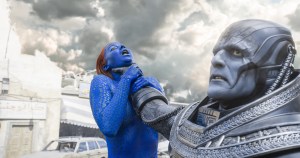
In this film, an ancient, evil, Egyptian deity is played by Oscar Isaac, a Guatemalan American actor from Miami.

Still, this casting is an improvement on “Gods of Egypt,” in which doughy Australian actor Geoffrey Rush portrayed the Egyptian god, Ra, in such a way that it made many older critics publicly apologize for having trashed John Wayne’s performance as Genghis Kahn.

The afore-referenced supervillain eventually names himself after the thing he most wants to bring about in the world: Apocalypse.

This is an interesting life strategy. It’s the reason I am renaming myself “Unlimited Free Tacos.”

In the comic books, Apocalypse is as big as a blue Hulk and seems to wear the chassis of a Buick Roadmaster as body armor.

So diehard fans were understandably a little disappointed to see Isaac wearing a costume that looked like it was designed for “Apocalypse: The Musical.”

Still, that won’t be enough to make a single one of them stay away from this, the eighth installment in Fox’s X-Men franchise.

Fox has a lot riding on this. It owns the movie rights to a few of the Marvel properties that Disney does not, and it has been a careless steward. Its “Fantastic Four” films have been comprehensively terrible. The only interesting thing about them was that they were all terrible in different ways.

Fox got lucky earlier this year with “Deadpool,” after years of showing that it had little understanding of the character and little interest in gaining an understanding.

Some pundits have reasoned that moviegoers, having already sat through “Batman v. Superman: Dawn of Justice” and “Captain America: Civil War” this year, will be suffering from superhero fatigue by the time this movie comes out.

Pundits have said this sort of thing before.

If superhero fatigue exists, it has yet to become an epidemic. Like cooties and the collywobbles, superhero fatigue appears to be something that is keenly experienced by certain individuals, yet is imperceptible by many others.

About a decade ago, Marvel Studios embarked on a cinematic initiative that involved what were then considered a dog’s breakfast of ancillary comics characters.

Everybody scoffed.

Now Marvel rules the roost.

Fox wants some more roost (Opens May 27).

ninjaturtles2

“Teenage Mutant Ninja Turtles: Out of the Shadows”

Roughly four years after University of Massachusetts student Kevin Eastman co-created the Teenage Mutant Ninja Turtles with Peter Laird, I started attending that august Amherst institution.

Later, as an A&E reporter for a local alternative weekly, I crossed paths with Eastman quite a bit.

Every so often, one would see him strolling down a sidewalk in Northampton with then-wife Julie Strain.

Strain, the oft-described “Queen of the B-Movies,” is about as tall as Lurch and as zaftig as Jessica Rabbit.

She made quite an impression, in other words.

Interestingly, even though the setting for “Teenage Mutant Ninja Turtles” has always been Manhattan, the “cityscapes” in the earliest comics were based on Northampton, a gentrified, ultraliberal and not-very-urban college town with a current permanent population of about 28,000.

It was even smaller back then.

I was in the audience for the “Northampton premiere” of the 1990 live-action film, which featured Jim Henson’s wonderful costumes.

I liked Michael Bay’s 2014 reboot more than I thought I would, but the special effects were odd and a little off-putting in the way CGI often is these days.

How do you create a compromise between an actual turtle and a cartoon turtle that is more ingratiating than horrific?

The apparent answer in this case was: You don’t. Under deadline, you throw up your computer-animating hands.

If you saw these computer-generated Ninja Turtles floating in glass jars in a lab in “Alien 4,” you’d think, “Well, that’s what you get when you try to combine Ellen Ripley’s DNA with monster DNA.”

But in this movie, they’re the adorable heroes!

Context is key.

CGI manifests wonderments that weren’t filmable in 1990, but I’d be lying if I said I don’t sometimes miss Henson’s rubber suits (Opens June 3).

warcraft2

“Warcraft”

When I heard that this CGI-heavy fantasy movie is based on a popular MMORPG, I must admit that I had to go look that acronym up.

It means Massaging Mustard Onto Really Putrefying Gizzards.

Believe me, I was as surprised as anyone.

Computer-generated gizzards.

We truly have come a long way.

No, “Warcraft: The Motion Picture” is, of course, an adaptation of a massively multiplayer online role-playing game of the same name.

The game might be revolutionary, but one word popped into the mind of this game-resistant moviegoer while watching the trailer: Derivative.

The director here is Duncan Jones, son of the late David Bowie and creator of two previous sci-fi films, both brainy.

The hiring of Jones reflects the big studio practice of recruiting independent directors to helm blockbusters because they’re talented and cheap.

It makes perfect sense, of course. “Look over here,” one studio executive might tell another. “It’s a young man who has directed a well-reviewed film about a boy who tries to help the Dutch resistance during World War II. He’d be the perfect person to direct our movie about murderous space cheese” (Opens June 10).

findingdory2

“Finding Dory”

Everyone’s favorite forgetful fish is back! Forget all those other forgetful fish. This is everyone’s favorite!

Trust me on that.

After the release of “Blackfish,” a documentary critical of Sea World’s treatment of killer whales, Pixar changed the ending of “Finding Dory” so that it casts marine parks of Sea World’s ilk in a slightly less flattering light.

The new conclusion of the film features a dolphin named Caesar staging a revolt at the Monterey Marine Life Institute and instituting new rules such as “Fish Shall Not Kill Fish,” among others (Opens June 17).

swissarmyman2

“Swiss Army Man”

Pundits are calling this the first movie about a farting corpse that has also starred Daniel Radcliffe.

I know it’s been a few years, but how is it that no one remembers “Harry Potter and the Farting Corpse”? (Opens June 24)

id1

“Independence Day: Resurgence”

I was 30 years old when the original was released, which is dead in “Logan’s Run” years.

I didn’t much like it.

To me, the movie was a cinematic junk drawer of bad special effects occasionally interspersed with spectacular special effects, lazy plotting, funny but often ill-timed humor (an Emmerlich/Devlin specialty in those days), and the worst creature designs since “Robot Monster.”

Seriously, guys. Those aliens. Those architecturally absurd heads, like trying to wear a jet ski as a hat. Eyes like spoons with the handles broken off. Cute little Norfin figurine faces. Tentacles, because…why the hell not?

Some of them had even more random crap stuck to them.

However, I will allow for the possibility that the movie had an impact on par with the original “Star Wars” on people who were 10 then and are 30 today.

So, it’s 20 years later and here’s the sequel.

Will Smith did not return because he is busy, Bill Pullman did return because he is not and Randy Quaid did not return because he has since gone certifiably insane (although he has thus far eluded attempts at certification).

Oh, and his character died, not that that means anything.

In this movie, military engineers have had 20 years to improve the planet’s defenses and outside this movie, cinematic engineers have had 20 years to improve this franchise’s special effects.

This sequel’s ace in the hole is Jeff Goldblum, in my opinion.

Everything goes better with Goldblum (Opens June 24).

legendoftarzan

“The Legend of Tarzan”

The first screen Tarzan, who Tarzan creator Edgar Rice Burroughs allegedly hated, was Elmo Lincoln.

I shall not mince words: Lincoln had dad bod. He had moobs.

Roughly fifty films and 100 years later, we’re getting “The Legend of Tarzan.”

In this latest iteration, Tarzan is played by Swedish actor Alexander Johan Hjalmar Skarsgård, who I will hereafter refer to as “Tarzan of the Moose.”

No, I won’t.

Skarsgård may have had a six-pack at some point, but he left it behind long ago. He may have subsequently had a 24-pack, but he also left that behind. These days, it appears as if his taut abdomen contains the equivalent in muscles of a commercial beer factory and four microbreweries.

His belly resembles a furnace filter.

I don’t think Burroughs would be very happy with that either.

Skarsgård is entirely too pretty to play Tarzan. He does not have the body of a man who grew up in the jungle with apes. He has the body of a man who went to the jungle and opened a Gold’s Gym.

Computer-generated effects will allow Tarzan to swing through the trees in a manner that no live-action Tarzan has up to now, so there’s that.

Disney, which is awash in cinematic universes these days, undoubtedly hopes this property turns into one. Burroughs wrote 24 novels of descending quality, so there’s more than enough material for Disney to ignore.

But I fear that kids aren’t returning to the source material in the numbers they once did and that makes me sad. They aren’t great books. They’re more fun and exciting than that.

I do not expect “The Legend of Tarzan” to do well enough to warrant a sequel and it will be a shame. Pretending to be Tarzan has gotten a lot of kids out of the house and into the woods (Opens July 1).

ghostbusters2

“Ghostbusters”

This gender-switch version of the classic comedy has already angered so-called men’s rights activists, a group of manly men who, ironically, always seem to behave as if they’re menstruating.

These men apparently wanted another movie written by Dan Aykroyd, who is currently working on a second animated “Blues Brothers” series, not that there’s anything wrong with that.

Oh, who am I kidding? There’s a lot wrong with that.

As has been pointed out elsewhere, Aykroyd had his chance with “Ghostbusters 2.” It’s not a horrible sequel, but it lacks the lightning-in-a-bottle quality of the first film.

Maybe the original Ghostbusters crew was like a rock band that forms, makes a great album or two and then runs out of steam. Like the Police.

Not like U2, in other words. The original cast was never meant to still be playing together in 2016. Some critics might suggest that even U2 isn’t meant to be U2.

I don’t know that I was dying for a new “Ghostbusters” film under any guise, but I seem to have entered the “get off my lawn” phase of my life, so I may not be the best judge.

A Paul Feig-directed reboot starring the best female comics available sounds like the best of the available options.

Still, some men will claim that their childhoods have been ruined.

What I want to say to these men is this: Clearly, your childhoods haven’t even ended yet. There’s still time to make things right (Opens July 15).

ice-age-collision-course1

“Ice Age: Collision Course”

The ongoing saga of a prehistoric squirrel (aka “Fox Studios”) on a seemingly ceaseless quest to gain possession of a nut (aka “milk a cinematic property until it is a desiccated husk”).

In their continued committed to paleontological and geological veracity, the creators of this installment decided to send the film’s prehistoric animals into space.

Fox has had a remarkable run with this series, but is this the installment where the franchise finally jumps the Carcharodon megalodon? (Opens July 22)

startrekbeyond

“Star Trek Beyond”

I speak as a four-decade trekker: This movie scares me.

We’ve seen one anemic trailer and zero publicity.

The only headlines “Star Trek” is getting these days are related to Paramount’s late-breaking and dunderheaded decision to start suing fans that make tribute films.

Could it be that Paramount knows it has a stinker on its hands and isn’t quite sure what to do about it?

This movie introduces a new alien species, which is always a dicey proposition. Sure, the Ferengi were a success, but how about the Space Hippies and the Space Mobsters and the Greek Gods from Space and the Offensive Irish Stereotypes from Space (aka the Bringloidi)?

I fear that the critical and commercial failure of this film would put a decisive end to the rejiggered universe that J.J. Abrams introduced in 2009.

We “Star Trek” fans have been here before, of course.

The last two “Next Generation” features put “Star Trek” into cryogenic suspension for a number of years.

A clean-slate TV series will debut in 2017, and if it’s strong enough, it’ll end up steering the whole franchise.

“Star Trek” will survive, but it may take a back seat to “Star Wars” for a while.

If you think the bickering between Clinton and Sanders backers is bad, you should see a “Star Trek” fan at a sci-fi convention try to convince a “Star Wars” fan that the former is superior.

I have seen enough lightsaber/bat’leth battles to last a lifetime (Opens July 22).

bourne2

“Jason Bourne”

Bourne spent the first three films trying to remember who he is, so I guess he’ll spend the next three trying to forget who he is.

What’s with the title? Where’s “The Bourne Redundancy” or “The Bourne Annuity” or “The Bourne Venerability”?

I’ll tell you thus much: “Jason Bourne” is perfectly positioned to be an antidote to a surfeit of summer CGI.

According to reports, director Paul Greengrass decided to abstain from using his standard “shaky cam” for this installment. Because he wanted to go shakier.

My hope is that Bourne is finally able to relax on a couch at the end of this franchise and hear the voice of his lovely wife calling out from the kitchen, “Would you stop killing people for a minute and take out the garbage?” (Opens July 29)

suicidesquad

“Suicide Squad”

A secret government agency named A.R.G.U.S is created by Amanda Waller, who I really want to believe previously ran a secret beef agency called A.N.G.U.S.

The idea here is that a team of potential superheroes is formed from a previously unaffiliated collection of unapologetic DC Comics supervillains.

Hollywood is showing its range here. It is proving that it can give you everything from superheroes to supervillains pretending to be superheroes.

In press about the film, this atypical team-up is often referred to as a “rogue’s gallery,” a term that hasn’t been in wide use since men were fined for cursing.

Jared Leto plays the latest incarnation of the Joker, and word has it that he stayed in character for the duration of the shoot, whether on-set or off. He even went so far as to send gifts to his fellow cast members that were meant to evoke Batman’s green-haired nemesis – gifts like bullets, sex toys, a live rat and a dead hog.

That reminds me of the time I played Georges in “La Cage Aux Folles” and sent everyone in the cast a gay butler.

Warner Brothers has decided to market “Suicide Squad” as a comedy on the assumption that even a movie with “suicide” in the title is bound to have more laughs in it than “Batman v. Superman: Dawn of Justice” (Opens August 5).
ninelives

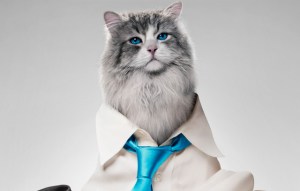
“Nine Lives”

Hand’s down, the most genuinely fascinating movie of the summer.

Typically, when studio execs start thinking of doing a “talking animal” version of “It’s a Wonderful Life,” there are certain people they tend to call.

Chevy Chase. Sinbad. Chris Kattan. Jim Belushi.

Those kinds of guys.

This time around, however, someone got a little bolder – perhaps a little crazier – and called Kevin Spacey.

To everyone’s eternal bewilderment, Spacey said, “Yes.”

A choice like this doesn’t usually happen when an actor is at the top of his game.

But Spacey’s been doing well.

Trailers for this movie are being shared on social media at the precise moment that Spacey is also touting online acting classes.

You rarely see irony bordered with so much neon (Opens August 5).

Trower’s Finest Hour: Robin Trower Always Saves the Best for Last

Standard

trower

In 1967, a respected British band in the midst of enjoying its first hit single came to guitarist Robin Trower and asked if he’d like to join up.

He said, “Yes,” of course.

From the point of view of an American fan of British Invasion rock, this proposition might seem like one with no discernable downside.

A perusal of that aforementioned single, “A Whiter Shade of Pale,” might change your perspective, however. There are many impressive things about the song, but one of them is not the prominence of the guitar.

Procol Harum was a piano-and-organ-based band, not that there’s anything wrong with that. But if Trower was going to get widely described as a “guitar god,” as eventually occurred, it wasn’t going to be as a member of Procol Harum.

Trower performs at C2G Music Hall on May 5.

In a phone interview, Trower characterized the songwriting of Procol Harum founders, Gary Brooker and Keith Reid, as “very forward-thinking.”

“It was Gary and Keith who wrote those songs and I just added my bit on the guitar,” he said.

Trower was writing a lot of guitar-driven songs on the side that he knew would never be played by the band. Eventually, he decided to take his leave in 1971.

“I needed more room,” he said. “I had a lot to say I wanted to get on and say it.”

But the parting was amicable, Trower said, and he left with no regrets over how he’d spent the previous four years.

“I learned a lot from Procol Harum,” he said. “The band gave me tools I absolutely needed to move forward.”

In 1974, Trower achieved his first monster success as a solo artist: the album, “Bridge of Sighs.”

Critics compared his sound to that of the late Jimi Hendrix.

Trower said he didn’t really discover Hendrix’ music until after he died. Reid wanted to find a way to pay tribute to Hendrix on the band’s “Broken Barricades” album and Trower listened to all of his music in preparation.

Trower became an enormous fan, of course, but he said he didn’t consciously try to incorporate Hendrix’ musicianship into his own style of play – it just happened naturally.

“I can revisit songs now and think ‘Oh, yeah. There’s the Hendrix influence,’” he said. “But at the time, I was just writing songs. I wasn’t stopping to think about what might have influenced them.”

Some critics were less than enamored with the Hendrix echoes in Trower’s music, but Trower said it would be silly for any serious electric guitarist to try to ignore Hendrix.

The guitar god label is one that Trower shares with such countrymen and contemporaries as Eric Clapton and Jeff Beck.

Some so-called guitar gods might feel ambivalent about that tag, but not Trower.

“I think it is flattering,” he said, “because the people who describe you in this way tend to place you alongside your own heroes.”

It is rare in the 21st century for a young axman to be granted this designation. Trower said he believes the guitar god era has come and gone.

“I can’t see younger musicians having the same inspiration as perhaps those of my generation had,” he said. “We were inspired by extremely gifted people. It may be that what musicians are being inspired by now is more second and third-hand.”

Guitar gods may have divinity in their playing, but many of them are known for deviltry in other areas of their life.

Trower is a relatively straight arrow. He doesn’t drink and has been married to the same woman for almost 50 years.

“We were married in ’68,” he said. “She was a very special lady. We both lived in the same town and we would run into each other in the sort of places where young people ran into each other back then.”

Trower, 71, is touring on extravagant praise for his latest album, “Where You Are Going To.”

Strong reviews are nice, Trower said, but he doesn’t count on them and never has.

“I’m making the records really for my own personal gratification,” he said. “If people like it, it’s great. It’s really great. But the most important thing to me is that I am happy with it.”