
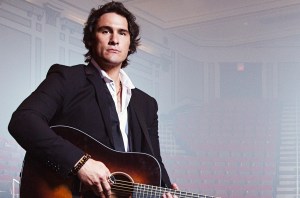
Joe Nichols said he’s been counted out plenty of times in the country music business, but he always seems to have another comeback in him.
This has conditioned him to roll with the lulls.
Nichols performs October 13 at the Honeywell Center.
Earlier this year, Nichols released a studiously traditional record called “Never Gets Old.” It sounds like something Randy Travis might have recorded in his prime.
Here’s why that was an edgy thing to do: Despite trend pieces to the contrary, the so-called bro-country subgenre is far from dead: songs sung (and partly rapped) by white guys about back roads, dirt roads, cheap beer, moonlight, tailgates, pickup trucks used for purposes other than keeping the wood from falling out, and women dressed like “Hee Haw Honeys.”
The nonsensically simplistic lyrics have an almost nursery rhyme quality that is calculated to drill songs into skulls.
The current number one hit on the country charts is Sam Hunt’s “Body Like a Back Road.” Hunt has been described as the guy who will save country radio from the clutches of bro country, but “Body Like a Back Road” may be the most bro country song ever.
In an article that mostly heaps extravagant praise on Hunt, Rob Harvilla of The Ringer website wrote, “The mainstream country conveyor belt requires artists to run a silly race that demeans the runners to the great amusement, but not so much the enrichment, of the spectators…Bottom line: good artist finds great success with bad song. ‘Body Like a Back Road’ is an expert bit of shameless pandering, giving the people exactly what they want and none of what they need.”
This is the business climate in which Nichols is trying to survive.
When asked about his return this year to a more traditional sound, Nichols doesn’t sound defiant.
He doesn’t thumb his nose at anything or anyone.
He said a musician who wants thrive would be foolish not to pay close attention to whatever is popular at any given moment.
“It’s like the stock market,” he said. “No one is going to question you when you invest in Netflix instead of Blockbuster.”
Nichols said he went old school after recent attempts to tap that still-rich bro country vein weren’t as successful as he’d hoped.
He consulted the people that he trusts the most and they all recommended that he take a break from chasing trends.
Songwriters aren’t to blame for the homogeneity of the songs on the charts at any given moment, Nichols said. Executives are.
“It’s corporate guys who want to turn $1 into $1.25,” he said.
Nichols said the corporate plan is working very well, which is why songwriters who want to write out of feeling rather than obligation have to work extra hard.
Social media has helped immensely, he said.
“A person can put out something independently and it can catch on fire,” he said.
Things were different when Nichols moved to Nashville from Rogers, Arkansas in his late teens.
The music industry as it had been known for more than a century had not yet collapsed by the mid-1990s, so getting signed to a label was the only way for an artist to excel.
Nichols said he was “scared to death” in Nashville at first.
“I only knew one person there,” he said. “I crashed at his house for the first couple of weeks until I found a little, bitty, terrible apartment.
“It was intimidating to say the least,” Nichols said. “That was 1997. The city was big; the music industry was daunting. It was full of people who were celebrities behind the curtain. The guys who pulled the strings. I was like, ‘How am I going to put myself in front of these guys?’”
Nichols had a couple of promising early encounters with labels small and big, but they went nowhere. He ended up having to take on a succession of odd jobs, including selling steaks door to door out of a freezer truck.
It may be that a man who can successfully sell meat door to door out of a freezer truck can sell anything to anybody, but Nichols was not that man.
He was fired after the first day.
When Nichols finally found success with the 2002 release of “Man with a Memory,” it wasn’t his salesmanship that people were responding to. It was his earnestness.
Perhaps Sam Hunt could sell meat door-to-door out of a freezer truck.
Nichols also had to wrestle with an unintended but common consequence of the pressures of mainstream success: a substance abuse problem.
“After 2004 or 2005, I don’t know if I thought I was bigger than I was or if I started hanging around with the wrong crowd,” he said. “I started getting sideways with everything. Not showing up for meetings. Doing things I shouldn’t have been doing. I just kind of felt like everything was out of control.”
Nichols said the death of his dad, a sometimes abusive, long haul trucker with whom he had a complicated relationship, accelerated the downward slide.
This all came to a head after Nichols had reunited with his high school sweetheart, Heather Singleton, and the thought of losing her gave him the resolve he needed to kick his habits.
“It was clear that there was only room for one of them, my party life or Heather,” he said. “So I had to change it and think about Heather.”
Ironically, one of Nichols’ biggest eventual hits was “Tequila Makes Her Clothes Fall Off,” a song written the perspective of a rueful yet amused husband.
It’s not a party anthem, but it doesn’t exactly condemn the drinking of mezcal either.
Nichols said the original version of the song, by Gary Hannan and John Wiggins, was sort of slow and sad so he punched it up (the country music equivalent of investing in Netflix, maybe).
The reason mainstream country adopted rock, pop and soul to the extent it has is because it was “always the red-headed stepchild of the music business,” Nichols said.
We have come a long way from the days when Garth Brooks was condemned by some country music fans for making too many concessions to the pop charts in his music.
“In the old days, you were taking a big risk if you put out a record that was perceived as an attempt to crossover,” Nichols said. “Nowadays the biggest risk is putting out something that is traditional.”
A guy who wants to make traditional music has to ask himself a hard question about how those songs will sound when played before and after what is currently popular, he said.
“That’s neither good or bad,” Nichols said. “It just is.”
Sometimes an “investment in Blockbuster” turns into a blockbuster.
But a guy has to be careful.
 aloadofthis